Nervous system is the organ system present in the animals to control and coordinate different activities of the body.
Nervous system comprises ofthe brain, thespinal cord, anda huge network of nerves thatare spread throughout the body.
The nervous system is responsible for sending, receiving and processing messages in the form of chemical signals called as impulses.
Nervous tissue is made up of an organized network of nerve cells or neurons.
It is specialized for conducting information via electrical impulses from one part of the body to another.
A neuron is the basic unit of the nervous system. Each neuron consists of three parts, namely, the cell body or cyton, branched projections called dendrites, the long process from the cell body, called the axon.
Synapse is a gap between two neurons.
Nerves are thread like structures emerging out of the brain and spinal cord.
Nerves branch out to all parts of the body and are responsible of carrying messages in the body.
Types of nerve cells or neurons:
Sensory nerves send messages from the sense organs to the brain or spinal cord.
Motor nerves carry messages back from the brain or spinal cord to all the muscles and glands in the body.
Interneuron or relay neuron connects neuron within specific regions of the central nervous system. These are neither motor norsensory.
Reflex action:
What happens in reflex actions?
A reflex action, differently known as a reflex, is an involuntary and nearly instantaneous movement in response to a stimulus.
Reflex is an action generated by the body in response to the environment.
The process of detecting signal or the input and responding to it by an output action might be completed quickly. Such a connection is commonly called a reflex arc.
Reflex arcs are formed in the spinal cord itself; although the information input goes onto reach the brain.
In higher animals, most sensory neurons do not pass directly in to the brain, but synapse in the spinal cord.
Reflex arc continue to be more efficient for quick response.
Human brain:
Types of nervous system
The nervous system is divided into two systems as
Central nervous system
Peripheral nervous system.
Central nervous system:
Central nervous system includes the brain and the spinal cord.
It receives information from the body and sends out instructions to particular organs.
The brain has three such major parts or regions namely the fore brain, mid brain and hind brain.
Forebrain:
The forebrain is the main thinking part of the brain.
It consists of the cerebrum and diencephalon.
The cerebrum is the seat of memory and intelligence, and of sensory centres like hear, smell and sight.
The diencephalon is the seat for pressure and pain.
Midbrain:
The midbrain connects the forebrain to the hindbrain and controls the reflexes for sight and hearing.
Hindbrain:
The hindbrain consists of the cerebellum, pons and medulla.
The cerebellum coordinates muscular activities and maintains balance and posture.
The medulla controls involuntary activities like blood pressure, salivation, vomiting and heartbeat.
The spinal cord extends from the medulla of the brain through the whole length of the vertebral column and is protected by the vertebral column or backbone. Peripheral nervous system:
Peripheral nervous system consists of the cranial and spinal nerves arises from the brain and spinal cord respectively.
How are the tissues protected? Human brain is protected by the thick bones of the skull and a fluid called cerebrospinal fluid which provides further shock absorption.
How does the nervous tissue cause action? When a nerve impulse reaches the muscle the muscle fibre must move.
The muscle cells will move by changing their shape so that they shorten.
Muscle cells have special proteins that change both their shape and their arrangement in the cellin response to nervous electrical impulses.
When this happens new arrangements of these proteins give the muscle cells a shorter form.
Coordination in plants:
All living things respond to environmental stimuli.
Plants also respond to stimuli with the helpof chemical compoundssecreted by thecells.
Plants being living organisms, exhibit some movements.
Plants show two different types of movements.
Types of movements shown by the plants are:
dependent on growth
independent of growth.
The plants also use electrical chemical means to convey this information from cellto cell but there is nospecialized tissue in plants for the conduction of information.
Plants respond to stimuli slowly by growing in a particular direction.
Because this growth is directional it appears as if the plant is moving.
Directional movements or Tropic movements:
Directional movements are also called as tropic movements.
Directional movements movements can be either towards the stimulus or away from the stimulus.
Positive phototropism is seen in shoots which respond by bending towards light.
Negative geotropism is seen in shoots by growing away from the ground.
Roots bend away from light exhibiting negative phototropism. They grow towards the ground exhibiting positive geotropism.
Hydrotropism is a growth response in which thedirection is determined by the stimuli of water.
Chemotropism is a growth movement of a plant part in response to chemical stimulus.
e.g. Growth of pollen tubes towards ovules.
Hormones
Hormones are the chemical compounds released by stimulated cells.
Hormones diffuse all around the cell.
They are synthesised at places away from where they act and simply diffuse to the area of action.
Different plant hormones help to coordinate growth, development and responses to the environment.
Different hormones secreted by the plants are auxins, gibberellins, cytokinins, abscisic acid.
Auxins are the hormones synthesised at the tip of the stem. These help the plants in growth by cell elongation.
Auxin induces shoot apicaldominance.
Gibberellins are hormones that help in the growth of the stem, seed germination, bolting, and flowering.
Cytokinins are hormones present in the areas of rapid cell division, such as fruits and seeds.
They also promote the opening of the stomata.
Abscisic acid is a hormone that inhibits the growth in various parts.
It is also responsible for the closure of stomata. Its effects include wilting of leaves.
Hormones in Animals: Endocrine system is the system formed by ductless glands which secrete chemical substances called as hormones.
Endocrine glands release hormones directly in to the blood. Hormones are minute, chemical messengers thrown into blood to act on target organs.
Endocrine glands
Different types of endocrine glands present in our body are the pituitary gland, pineal gland, hypothalamus, thyroid, parathyroid, thymus, adrenal gland, pancreas, testes and ovary.
Adrenal glands:
These are located above kidneys.
Two regions of the adrenal gland are adrenal cortex and adrenal medulla.
• Adrenal cortex secretes the hormones like cortisol, aldosterone and androgens.
• Adrenal medulla secretes the hormones like adrenaline andnoradrenaline.
Adrenaline is also called the “hormone of fight or flight,” or the emergency hormone.
It prepares the body to face an emergency condition of physical stress, like danger, anger and excitement.
Thyroid gland:
• It is located in the neck, ventral to thelarynx. • It is the one of the largest endocrine glands. • The principal hormones produced by this gland are triiodothyronine and thyroxine.
• Thyroxine is a hormone that regulates the metabolism of carbohydrates, proteins and fats in the body.
Iodine is essential for the synthesis of thyroxin.
Deficiency of iodine in food causes goiter.
One of the symptoms of this disease is a swollen neck.
The pituitary gland:
• It is located at the base of the brain. • It is considered to be master gland as it secretes many hormones to regulate organs as wellas the other glands. • Different hormones secreted by this gland include Growth hormone, TSH, FSH, LH, ACTH, MSH, Vasopressin and Oxytocin.
Growth hormone regulates growth and development of the body. If there is a deficiency of this hormone in childhood, it leads to dwarfism.
Excess secretion of this hormone leads to gigantism.
Gonads:
Two types of gonads present in human beings are female gonads and male gonads.
Female gonads
• A pair of ovaries forms the gonads in female. • Ovaries are the female sex organs that lie one on either side of the abdominal cavity.
Ovaries produce two hormones, namely, oestrogen and progesterone. • Oestrogencontrols the changes that occur during puberty, like feminine voice, soft skin and development in mammary glands. • Progesterone controls the uterine changes in the menstrual cycle, and helps in the maintenance of pregnancy.
Male gonads
• A pair of testes forms the gonads in males. • A pair of testes isthe male sexorgan located inthe scrotum, whichis outside theabdomen. • Testes produce the hormone testosterone. • Testosterone controls the changes, whichoccur during puberty, like deeper voice, development of penis, facial and bodyhair.
Pancreas: It is located just below the stomach within the curve of the duodenum. It is both exocrine and endocrine in function. • It secretes hormones such as insulin, glucagon, somatostatin and pancreatic polypeptide. • Insulin regulates the sugar level inour blood.
Insulin secreted in small amounts increases the sugar level in our blood which in turn causes a disease called diabetes mellitus.
Pineal gland: • It is located near the centre of the brain, dorsal to the diencephalon. • It produces the hormone melatonin. • Melatonin affects reproductive development, modulation of wake and sleep patterns, and seasonal functions.
Hypothalamus: • It is a neuro-endocrine part of the brain. • It links the nervous system and the endocrine system through the pituitary gland. • Hormones likeStomatostatin, Dopamine aresecreted by thisgland.
Parathyroid glands:
• These are two pairs of small, oval-shaped glands embedded on the dorsal surface of the thyroid gland present in theneck. • They secrete parathormone.
parathormone helps in regulation of calcium and phosphate ions inthe bones and blood. • Hypo secretion leads to tetany and hypersecretion causes osteoporosis.
Thymus gland:
• It is located infront of the heart, in the upper part ofthe sternum. • It produces the hormone thymosine. • It helps in the maturation of T-lymphocytes.
The timing and amount of hormones released are regulated by feedback mechanisms.
For example, if the sugar levels in blood rise, they are detected by the cells of pancreas which respond by producing more insulin.
As the blood sugar level falls, insulin secretion is reduced.
Hindi Version
Dig Deep
Topic Level Resources
Sub – Topics
Select A Topic
Topic:
Chapters Index
Select Another Chapter
[display-posts category=”CBSE 10 – Science – Study – Premium” posts_per_page=”25″]
Welcome to The Right Mentor – The Ultimate Educator.
Chapter 8 – How do Organisms Reproduce?
1. Do organisms create exact copies of themselves? Chromosomes in the nucleus of a cell contain information for inheritance of features from parents to next generation in the form of DNA molecules. The DNA in the cell nucleus is the information source for making proteins. If the information is changes, different proteins will be made. Different proteins will eventually lead to altered body designs. Therefore, a basic eventin reproduction is the creation of a DNA copy. DNA copying is accompanied by the creation of an additional cellular apparatus and then the DNA copies separate each with its own cellular apparatus. Effectively a cell divides to give rise to twocells. The process of copying the DNA will have some variations each time. As a result the DNA copies generated will be similar but may not be identical to the original.
1.1 The importance of variation
The consistency of DNA copying during reproduction is important for the maintenance of body design features that allow the organism to use that particular niche. Reproduction is therefore linked to the stability of populations of species.
Variations are beneficial to the species than individual because sometime for a species, the environmental conditions change so drastically that their survival becomes difficult. For example, if the temperature of water increases suddenly then most of the bacteria living in that water would die. Only few variants resistant to heat would survive and grow further. However, if these variants were not there then the entire species of bacteria would have been destroyed. Variation is ths useful for the survival of species over time.
2. Modes ofreproduction used by single organisms Reproduction is the phenomenon which involves the production of an offspring by particular individual or individuals to propagate their species. Reproduction is done during reproductive phase.
Types of reproduction Reproduction can be of two different types, namely, asexual reproduction and sexual reproduction.
Asexual modeof reproduction: It is a modeof reproduction in which a single individual is responsible forcreating a new generation ofspecies.
Sexual mode of reproduction: It is a mode of reproduction in which two individuals are responsible for creating a new generation of species. Reproduction in unicellular organisms is different from that of the reproduction in multicellular organisms. Most often unicellular organisms reproduce asexually. Some of them can also exhibit sexual mode of reproduction. Unicellular organisms reproduce asexually through fission, fragmentation, regeneration, budding, vegetative propagation and sporeformation.
2.1 Fission: For unicellular organisms, cell division, orfission leads tothe creation of new individuals. Fission can betransverse binary fission or longitudinal binary fission or multiple fission.
Transverse binary fission is thesplitting of thecells along anyplane during division.
e.g. amoeba
Longitudinal binary fission isthe division occurring in a definite orientation in relation to the whip-like structures located at one end ofthe cell. e.g. Leishmania.
Multiple fission is the division of mother cellinto many daughter cells simultaneously.
e.g. Plasmodium.
2.2 Fragmentation: This is the process in which theorganism breaks up into smaller pieces on maturation. Each fragment growsinto a new individual.
e.g.Spirogyra.
2.3 Regeneration: Many fully differentiated organisms have the ability to give rise to new individual organism from their body parts. That is if the individual is somehow cut or broken up into many pieces, many of these pieces grow into separate individuals. This is known as regeneration.
Eg:Planaria, Hydra.
2.4 Budding: A protuberance likeoutgrowth called as bud growsand detaches fromthe parent to develop into a separate organism. Each bud develops into a tiny individual.
e.g.Hydra.
2.5 Vegetative propagation This is the mode by which plants reproduce asexually. It involves the production of new plants fromthe vegetative partsof an existing plant. Different methods of vegetative propagation in plants include stem cutting, layering and grafting.
Grafting involves fusion of tissues of one plantwith those of another plant. Grafting is a vegetative method of propagation for apples and roses. Leaf buds can grow as young plantsin Bryophyllum. When the leaftouches moist soil, each bud growsinto a newplantlet. Rhizomes are horizontal, underground plant stems withshoots and rootsserving as reproductive structures. Advantages: Plantsraised by vegetative propagation can bearflowers and fruits earlier than thoseproduced from seeds. All plants produced are genetically similar enough to the parent plantto have allits characteristics.
2.6 Spore formation: Sporangia which contain cells or spores that eventually develops into new individuals. Spores are very light and are covered by thick walls that protect them. Spores germinate into new individuals on moist surfaces. e.g. Rhizopus.
3. Sexual Reproduction:
3.1 Why the sexual mode of Reproduction? Sexual reproduction involves two organisms, the male and the female in the process of producing the offspring. Sexual reproduction provides greater variations in the DNA thereby making the offspring adapted for better survival. Sexual reproduction ensures a mixing of the gene pool of the species. Due to genetic recombination, variations occur in the process of sexual reproduction.
During Sexual reproduction the combination of DNA from two parents would result in the offspring having twice the amount of DNA. To solve this problem, sexually reproducing individuals have special germcells (gametes) withonly half thenormal number of chromosomes and, therefore half the amount of DNA compared to the other cells of the body. When such germ cells from two individuals untie during sexual reproduction the normal chromosome number and DNAcontent are restored.
In multicellular organisms body designs become more complex, thegerm cells alsospecialize. One germ cell is large and contains the food stores while the other is smaller and likely to be motile. The motile germ cell is called the male gamete and germ cell containing the stored foodis called the female gamete.
3.2. Sexual Reproduction in flowering plants Plants reproduce sexually by producing male gametes in the form of pollen and the female gametes in the form of eggs. The reproductive parts of angiosperms are located in the flower. A flower comprises sepals, petals, stamens and carpels. Stamen and carples are the reproductive parts ofa flower whichcontain germ cells.
A unisexual flower contains either stamens or carpels. Forexample, papaya andwatermelon are unisexual flowers.
A bisexual flowercontains stamens as well as carpels. For example, hibiscus and mustard flowers are bisexual.
Stamen is the male reproductive part and it produces pollen grains. Carpel is present in the centre of a flower and is the female reproductive part. It consists of the ovary, style and stigma. The ovary is the swollen part at the bottom of the carpel. Ovary contains the female gametes in the form of eggs or ovules. The male germ cell produced by pollen grain fuses with the female gamete present in the ovule. This fusion of the germ cells or fertilization forms thezygote which is capable of growing into a new plant. The transfer of pollen grains from the anther to thestigma of the carpel is known as pollination. Twotypes of pollination are self-pollination andcross-pollination. Self- pollination involves the transfer of pollen grains from anther to the stigma of the same flower. Cross-pollination involves the transfer of pollen grains from anther of one flower to the stigma of another flower. This transfer of pollen from one flower to another is achieved by agents likewind, water or animals.
After the pollen lands on a suitable stigma it has to reach the female germ cells which are in the ovary. For this a tube grows out of the pollen grain and travels through the style to reach the ovule. Inside the ovule a male germcell fuses witha female germcell and formsa zygote. This is known as fertilization.
After fertilization, the zygote divides repeatedly to form an embryo which resides inside the seed. The ovule develops into a seed. The ovary ripens to form a fruit. Meanwhile the petals, sepals, stamens, style and stigma may fall off. Seed inside the fruit encloses the embryo, the future plant. The seed contain the future plant or embryo which develops into a seedling under appropriate condition. This process is known as germination. The factors essential for germination are nutrients, water and proper temperature. Seed has an embryo protected by reserved food materials in the form of cotyledons and also an outer covering called as seed coat.
3.3 Reproduction in Human Beings. Humans use a sexual mode of reproduction. Reproductive phase is the phase in the life of every individual which makes the individual capable of reproducing the offspring. In the early reproductive phase, individuals acquire changes in the bodywhich result in the formation of germ cells. Sperms are malegerm cells andeggs are female germ cells. Reproductive phase involves thechanges in appearance and size of the bodily organs. Adolescence is the period of life that leads to sexual maturity. During this period of life, one can observe many changes in the body. Puberty is the period at the beginning of adolescence when the sex glands in a boy and a girl are capable of reproduction. Different changes in boys include change in the voice, active functioning of sweat and sebaceous glands, growth of facial and body hair, enlargement of penis etc. Different changes in girls include growth of pubic hair, active functioning of sweat and sebaceous glands, menstrual cycle, enlargement of breasts.
3.3 (a) Malereproductive system This system includes a pair of testis, vas deferens and a muscular organ, the penis. Testes are placed in a structure called as scrotum which is located outside the abdominal cavity because sperm formation requires a lower temperature than the normal body temperature. Testes produce the male gametes known as sperms. Testosterone is the male sex hormone secreted by the testes. It regulates the development of sperms and the secondary sexual characteristics leading to puberty. The vas deferens is a tube that carries sperm from the testes. The urethra forms a common passage for both the sperm and urine as it is just one tube that connects both the glands – urinary bladder and vas deferens. Prostate gland and seminal vesicles secrete semen to make the movement of sperms easier and also provides nutrition. The sperms are tiny bodies that consist of mainly genetic material and along tail that helps them to move towards thefemale germ cell.
3.3 (b) Female Reproductive System. This system includes a pair of ovaries, a pair of oviducts, uterus and vagina opening out through urethra. Eggs, the female gametes develop inside the ovaries. One mature egg is released by either of the ovaries per month. Ovaries secrete two hormones namely estrogen and progesterone which bring about secondary sexual characters in females. The egg is carried from the ovary to the uterus through a thin oviduct or fallopian tube. The two oviducts combine and open into an elastic bag-like structure known as the uterus. The uterus opens into vagina through cervix. The uterus helps in the development of the foetus. The sperm enter through the vaginal passage during sexual intercourse. The sperms begin moving up the vagina and uterus, finally reaching the fallopian tubes. The fertilized egg, the zygote gets implanted in the lining of the uterus and starts dividing. It divides repeatedly to form an embryo. Embryo gets implanted in the lining of the uterus forfurther development. The placenta is a connective tissue established between foetus and themother. It contains villi on the embryo’s side of the tissue. It provides a large surface area for the nutrients and oxygen to pass from mother to the embryo. It also helps in transporting excretory wastes from embryo to mother. Thedevelopment of thechild inside themother’s body takesapproximately nine months. The child is born as a results of rhythmic contractions of the muscles inthe uterus.
3.3 (c) what happens when the egg isnot fertilized? If the egg is not fertilized it lives for about one day. Since the ovary releases one egg every month the uterus also prepares itself every month to receive a fertilized egg. Thus its lining becomes thick and spongy. This would be required for nourishing the embryo if fertilization has taken place. Now, however the lining is not needed any longer. So the lining slowly breaks ans comes out through the vagina as blood and mucous. This cycle take place roughly everymonth and isknown as menstruation. It usually lasts for about 2-8 days.
3.3 (d) Reproductive Health. Reproductive health is concerned with healthy and safe sexual practices. Unhealthy practices can lead to the transmission of disease from one partner to another and even to the offspring. Reproductive health also depends on healthy behavior and outlook towards sex life. Sexual maturation andbody growth aregradual processes. Evenwith some degree of sexual maturation the body and mind are not mature enough for a sexual act, childbearing and bringing up children. As, sexual intercourse involves intimate physical contact between the male and female sex organs, it may transmit certain disease from one partner to another. Such diseases are called sexually transmitted disease (STDs). e.g. Bacterial infections such as gonorrhoea andsyphilis, viral infections such as warts andHIV.
Contraceptive devices are the devices which block the entry of sperm into oviducts thereby preventing the egg from being fertilized. These devices help to prevent transmission of many infections to some extent. e.g. Copper-T or intra uterine contraceptive device (IUCD) placed in the uterus blocks the passage of sperm. Contraceptive drugs can alsobe taken orally aspills to avoid pregnancy. Condoms on the penis or similar coverings worn in the vagina can also be used. Surgical methods like vasectomy in males to block the vas deference so that sperm transfer be prevented and tubectomy in females to block the fallopian tube which makes theegg unreachable to uterus areproven to be contraceptive methods. Surgical methods aresafe in the long run.
Surgery can also be used for aborting unwanted pregnancies. However, this is often misused for illegally aborting female fetuses. To prevent female foeticide (killing of a foetus), prenatal sexdetermination has been prohibited by law.
Use the below buttons to explore our free services to find more…
Hindi Version
Dig Deep
Topic Level Resources
Sub – Topics
Select A Topic
Topic:
Chapters Index
Select Another Chapter
[display-posts category=”CBSE 10 – Science – Study – Premium” posts_per_page=”25″]
1. Accumulation of variation during Reproduction. Variations in an individual may be an advantage or disadvantage for it. It may enable or disable it to cope with changes in the environment. Advantageous variations are selected by environmental factors. For example bacteria that can withstand heat will survive better in a heat wave. Such heritable variations lead tothe evolution andformation of newspecies. An advantage of sexual reproduction is that the variations accumulated in the gametes of each sex are combined when they fuse to form the zygote. Hence an offspring produced from the zygote receives and carries the variations of both the parents. On the other hand, in asexual reproduction there are minor differences among the offspring. These are due to small errors in DNA copying. As gametes and zygote formation are not involves the asexually produced offspring arequite similar. Theyhave fewer variations accumulated over generations.
2. Heredity: The process ofpassing traits fromparent to offspring is called heredity. Trait is any characteristic thatis transferred fromparent to offspring. e.g. height and colour. 2.1 inherited traits. In humans, eye color is an example of an inherited characteristic: an individual might inherit the brown-eye trait from one of the parents. Inherited traits are controlled by genes and the complete set of genes within an organism’s genome is called itsgenotype. 2.2 Rules for theInheritance of traits- Mendel’s contributions: Gregor Johann Mendel was a pioneer among geneticists who put forward the concept of inheritance of characteristics or traits from parent to offspring. Mendel proposed the principle of inheritance and is known as the “Father of Genetics”. Mendel has chosen pea plants for his experimentation and found variations among them. Gene is a structural and functional unit of heredity and variations. Gene is a DNA segment on the chromosome. Genes control the expression of characteristics. Mendel called the genes to be factors. Traits can be either dominant or recessive. Tallness in a plant is a dominant trait, controlled by a dominant allele and is represented by “T” (capital). Shortness in a plant is a recessive trait, controlled by a recessive allele and is represented by “t” (small). · Homozygous is a condition in which a gene possesses a pair ofthe same alleles (TT or tt)for a single characteristic. · Heterozygous is a condition in which a gene possesses a pair of different alleles (Tt) fora single characteristic. Phenotype is a morphological expression of a single character. For example, tallness or shortness represents the phenotype of the plant. Genotype is the genetic make-up of a cell, an organism, or an individual (i.e. the specific allele make-up of the individual), usually with
reference to a specific characteristic under consideration. Alleles combine to make agenotype, such as TT or Tt or tt. Punnettsquare is a statistical method that was usedby Mendel to predict thepossible genotypes andphenotypes of the offspring.
Monohybrid inheritance It is the inheritance ofa single characteristic controlled by different alleles of thesame gene. · F1 generation is thefirst filial generation offspring produced by crossing twoparental strains. visible. All the progeny of F1 generation weretall i.e. thetraits of onlyone parent were · generation isthe second filial generation offspring produced by crossing F2 F1’s. TheF2 progeny were not all tall. Instead, one quarter of themwas short indicating both the traits – that oftallness and shortness were inherited inthe F2 plants. · Genotypic ratio – 1:2:1, Phenotypic ratio – 3:1. Dihybrid inheritance It is thesimultaneous inheritance oftwo characters. Dihybrid inheritance is theexperimentation of twocharacteristics with their four contrasting traits. For instance, dihybrid inheritance involves a plant producing round and yellow seeds (RR and YY) crossing with a plant producing wrinkled green seeds(rr and yy). · · F1 progeny produces roundand yellow seeds(R and r, and Y and y)in which roundand · yellow are dominant traits. F2 progeny were similar to their parents and produced roundyellow seeds, whilesome of · them produced wrinkled green seeds. However, some plants of the progeny even showed new combinations, like round-green seedsand wrinkled-yellow seeds. Thus the tall/ shorttrait and theround seed/wrinkled seedtrait are independently inherited. F2
2.3 How do thesetraits get expressed? A section of DNA that provides information for one protein is called the gene for that protein. The proteins synthesized according to this information may be enzymes that catalyse biochemical reactions. Each trait is the outcome of several suchbiochemical reactions eachof this is controlled by a specific enzyme. Each parent contributes one copy of the gene for a particular character. Thus there are two genes for every character. In the gamete, however, only one copy is present because of reduction division and these may be either maternal or paternal origin. When two germ cells combine they will restore the normal number of gene copies in the progeny ensuring the stability of theDNA of thespecies.
2.4 Sex determination It is a mechanism which determines the individual to be a male or a female based on the sex chromosomes present in it. In human beings, sex is determined by genetic inheritance. Genes inherited fromthe parents determine whether an offspring will be a boy or a girl.Gene for all
the characters are linearly arrange on the chromosomes. The chromosomes that carry genes for sexual characters are called autosomes or sex chromosomes while those that carry genes for the vegetative characters are called autosomes ornon sex chromosomes. Women have XX chromosomes whilemen have XY. All the children will inherit an X chromosome from their mother regardless of whether they are boys or girls. Thus the sex of the children will be determined by what they inherit from their father.
3. Evolution: All the life on Earth has descended from a common ancestor. Evolution is the sequence of gradual changes over millions of years in which new species are produced. Charles Robert Darwin was an English naturalist who observed various species of life on the earth and put forward the idea of “evolution of species by natural selection.” He said that a species inherits its characters from its ancestors. Acquired and inherited traits: An acquired trait is not transmitted to the off spring. In sexually reproducing organisms germ cells are produced in the reproductive organs, while the rest of the body has somatic cells. Changes in somatic cells due to environmental factors are not transmitted to the offspring. This is because a change in a somatic organ caused by a physiological response by the body does not bringabout a corresponding changein reproduction organs. A trait or character that is genetically inherited or passed down from generation to generation is known as inherited trait. Hugo de Vries explained the mechanism of heritable variations. According to him heritable variations arise when there is a change in the genes of the germplasm. He called it mutation. If a particular trait spreads in the population, it means that is favuored by natural selection.
4. Speciation: Speciescan be defined as a group of individuals ofthe same kindthat can interbreed and produce fertile progeny. Speciation: It is an eventthat splits a population into two independent species which cannotreproduce among them.
· Process of speciation-Genetic drift: It occurs due to changes in thefrequencies of particular genes by chance alone. e.g. If a hurricane strikes the mainland, and bananas with beetle eggs on themare washed away to an island. Thisis called a genetic drift.
· Process of speciation – natural selection: These are the variations caused in individuals due to natural selection which lead to the formation of a new species. e.g. If the ecological conditions are slightly different on the island as compared to the mainland, it leads to a change in the morphology and food preferences in the organisms over the course of generations.
Process of speciation -splitting of population: A population splits into different sub- populations due to geographical isolation thatleads to theformation of a new species.
Natural selection: It explains that organisms that are physiologically or behaviourally betteradapted for theenvironment are selected. Selected organisms can survive and reproduce.
Genetic drift: It is the genetic variation in smallpopulations caused by a specific environmental factor. Gene flow: It is the transfer of genes from one population to another due to migration. Breeding between the brown and green beetles introduces new gene combinations into the population. Over generations, genetic drift will accumulate different changes in each sub population. Also, natural selection may also operate differently in the different geographic locations. Speciation due to inbreeding, genetic drift and natural selection will be applicable to all sexually reproducing organism. 5. Evolution and Classification: Characteristics are the hereditary traits transmitted from parent organisms to their offspring. These are details of appearance or behavior in other words a particular form or a particular function. It shows how closely organisms are related with respect to evolution. The more characteristics two species will have in common, the more closely they are related. And the more closely they are related, the more recently they will have had a common ancestor. For example, a brother and a sister are closely related. They have common ancestors in the first generation before them, namely their parents. A girl and her first cousin are also related, but less than the girl and her brother. This is because cousins have common ancestors, their grandparents in the second generation before them, not in the first one. 5.1 Tracing Evolutionary relationships: Characteristics are of two types namely, homologous characteristics or analogous characteristics. · Homologous characteristics are organs that have the same basic structure and origin, but different functions. For example, mammals, birds, reptiles and amphibians have four limbs with the same basic limb layout because they have inherited the limbs from a common ancestor. These limbshave been modified to perform different functions. · Analogous characteristics are organs that have different structures and are of different origin, but perform same functions. For example, the design of the wings of bats and the wings of birds look similar because they have a common purpose – to fly.
5.2 Fossils:
Usually, when organisms die, their bodies will decompose and be lost. But sometime some body parts may not decompose completely and they will eventually harden and retain the impression of the body parts. All such preserved traces of living organisms are called fossils. Fossils are the remains or traces of a plant or animal that existed in a past geological age, and that has been excavated from the soil. Fossilisation is the process in which an organism is converted into a fossil. Paleontology is the study of fossils.
There are two ways to determine the age of fossils. One way is to dig the earth and start finding fossils. The second way of dating fossils is by detecting the ratios of different isotopes of the same element in the fossil material.
5.3 Evolution by Stages:
Evolution is a gradual process- no organism evolved suddenly. Complex organs evolved in organisms gradually. The eyes of the octopus and the eyes of vertebrates have evolved independently. These similarities of structure, despite of different origins provide a classic example of biological convergence. Biological convergence is a phenomenon by which two unrelated organisms become quite alike after a period of time through few generations, if it is assumed that they have a common ancestor. A change that is useful for one property to start with can become useful for quite a different function. Forexample, long feathers were considered to provide insulation in cold weather. Some reptiles like the dinosaur had feathers but very few were adapted for flying. In the present day, birds use feathers for flight, which is an example of adaptation. It is a characteristic of a particular animal may, post-evolution be useful for performing a totally different function. It is all very well to say that very dissimilar looking structures evolve from a common ancestral design. It is true that analysis of the organ structure in fossils allow us to make estimates of how far back evolutionary relationships go. The wild cabbage plant is a good example. Broccoli, kohlrabi and kale areproduced from itsancestor wild cabbage by artificial selection. Another way of tracing evolutionary relationships depends on the changes in DNA during reproduction. Comparing the DNA of different species should give us a direct estimate of how much the DNA has changed during the formation of new species. This method is now extensively used to define evolutionary relationships.
6. Evolution should not beequated with progress.
Evolution is simply generation of diversity and the shaping of the diversity by environmental selection. It is not as if the newlygenerated species arein any way better than the olderone. It is just natural selection and genetic drift have together led to the formation of a population that cannot reproduce with the original one, as in case of the evolution of humans and chimpanzees froma common ancestor. In evolution thenew forms evolved are more complex than their ancestors. It is theadaptability of a species to the environment that supports its survival not the complexity of the species. Each species, whether complex or simple is subjected to natural selection. Each species hasto go through the process of natural selection to survive andreproduce. In evolutionary terms, we cannot say that a particular species has a better design than another. Each species is well suited and adapted to its environment and hence is good enough to live andreproduce.
6.1 Human Evolution: The tools used to traceevolutionary relationships are excavation, time-dating, studying fossils, and determining DNA sequences have been usedfor studying human evolution. All the human beings in the world, whether they are African or American, share the same gene pool and hence all modern humans belong to the same species- Homo sapiens. There are, however, a large number of genes in the gene pool that serve as the source of individual variations. It is forthis reason that no two individuals are identical in looks, abilities, behavior, etc. therefore, there is great diversity in human features such as skin colour, height, hair colour, and so on. But there is no biological basis for assuming that humans with different features belong to different races.
Hindi Version
Dig Deep
Topic Level Resources
Sub – Topics
Select A Topic
Topic:
Chapters Index
Select Another Chapter
[display-posts category=”CBSE 10 – Science – Study – Premium” posts_per_page=”25″]
Introduction To Reflection and Refraction of Light
Light travels in a straight path in a uniform medium.
The light that bounces back when it strikes a smooth or roughOpaque surface is called reflection of light.
Light bends when it travels from one transparent medium to the other transparent medium at the surface that separates the two transparent media. Such a phenomenon is called Refraction of light.
Reflection of light
Reflection of light is of two types they are:
(i) Specular or Regular
(ii) Diffused or Irregular Reflection.
(i) Regular reflection
Definition: Regular reflection, also known as specular reflection, occurs when light rays strike a smooth surface and reflect at a consistent angle.
Key Characteristics:
Surface Type: Smooth surfaces, such as mirrors or calm water. Angle of Incidence = Angle of Reflection: The angle at which the incoming light strikes the surface (angle of incidence) is equal to the angle at which it reflects off the surface (angle of reflection). Image Formation: Produces clear and defined images, as the light rays remain organized. Applications: Used in mirrors, optical instruments, and various imaging technologies.
(ii) Diffused or Irregular reflection
Irregular reflection, or diffuse reflection, occurs when light rays strike a rough or uneven surface, scattering the light in multiple directions.
Key Characteristics:
Surface Type: Rough surfaces, such as paper, walls, or unpolished wood. Scattering of Light: Light rays reflect at various angles, leading to a diffuse spread of light. No Clear Image: Does not produce a clear image; instead, it illuminates the surface uniformly. Applications: Used in everyday scenarios for visibility, such as in rooms and outdoor environments, where light needs to be diffused for better illumination.
Laws of Reflection
In the case of reflection, The light obeys two laws of reflection as follows.
(i) angle of incidence, i is equal to the angle of reflection, r. Mathematically, it is represented as: ∠i = ∠r
(ii) The incident ray, The normal ray and reflected ray lie in the same plane.
The image formed by a mirror, such as a plane mirror and a spherical mirror are due to regular reflection of light.
Based on the nature of images formed by the mirrors, the images are of two types they are:
Real images
Virtual Images
Real images are the images which can be captured onto a screen.The real images are formed when the light rays really meet at a point.
Example, Slide projector in a cinema hall forms an image on the screen.
Virtual images are the images which cannot be caught on a screen.
The virtual images are formed when the light ranys really do not meet at a point.
But they appear to be images formed by the meeting of light rays.
Note:
The virtual images can be viewed with our naked eyes.
For example, the images formed due to reflection of light by a plane mirror of a dressing table and parking (convex) mirror.
Types of Mirrors
Generally the mirrors are classified into the following two types as:
Plane mirrors
Curved mirrors.
Generally mirrors refer to plane mirrors. But if the surface of a mirror is curved it is said to be a curved mirror.
Examples:
Concave mirror, convex mirror and Elliptical mirror etc.,
If the curvature of a mirror is a huge sphere, the mirror is said to be a spherical mirror.
Examples:
Concave mirror, convex mirror
Spherical mirrors are a special type of curved mirror.
Characteristics of Image Formed By A Plane Mirror
*The image formed by a plane mirror is unmagnified, virtual and erect.
*The image formed by a plane mirror has right-left reversal known as lateral Inversion.
*Focal length of a plane mirror is infinite.
*Power of a plane mirror is zero.
*If a plane mirror is turned by an angle, θ , the reflected ray turns by 2θ .
*The least size of a plane mirror to view an object is equal to half the size of the object.
A mirror that has a curved reflecting surface is said to be a curved mirror.
Spherical Mirrors
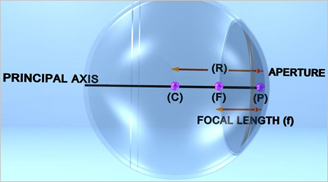
*Pole – The geometric centre of the reflecting surface of a spherical mirror is its pole. It is represented by P.
*Centre of curvature – The centre of the curvature of the reflecting surface of a spherical mirror is known as centre of curvature. It is represented by C.
*Centre of curvature in a convex mirror lies behind the mirror.
*But it lies in front of the mirror in a concave mirror.
*Radius of curvature – The radius of the reflecting surface of the spherical mirror is known as radius of curvature. It is represented by R.
*Principal axis – Straight line passing through the pole and centre of curvature in a spherical mirror is known as principal axis.
*Principal focus – The reflected rays appear to come from a point on the principal axis, known as principal focus. Principal focus (F) is the point on the principal axis, where a parallel beam of light, parallel to the principal axis after reflection converges in the case of a concave mirror and appears to diverge from in the case of a convex mirror.
*Focal length – The distance between the pole and the principal focus in a spherical mirror, known as focal length and it is represented by f.
*Note: Radius of curvature is twice the focal length (R=2f). In other words, The focal length is half the radius of curvature.
*Focal plane: A plane, drawn perpendicular to the principal axis such as it passes through the principal focus is called the focal plane.
*Aperture – The diameter of the reflecting surface is known as its aperture. The size of the mirror is called its aperture. In other words It is also defined as the effective diameter of the light reflecting area of the mirror.
If the curvature of a mirror is a huge sphere, the curved mirror is said to be a spherical mirror.
The reflecting surface of a mirror can be curved inwards or curved outwards.
Curved mirrors and Spherical mirrors are classified into the following two types:
Concave mirrors
Convex mirrors.
A curved mirror or a spherical mirror whose reflecting surface is curved inward is known as a concave mirror.
Conversely, A curved mirror or a spherical mirror whose reflecting surface is outward curved is known as a convex mirror.
Terms Associated with Spherical Mirrors
*Pole – The geometric centre of the reflecting surface of a spherical mirror is its pole. It is represented by P.
*Centre of curvature – The centre of the curvature of the reflecting surface of a spherical mirror is known as centre of curvature. It is represented by C.
*Centre of curvature in a convex mirror lies behind the mirror.
*But it lies in front of the mirror in a concave mirror.
*Radius of curvature – The radius of the reflecting surface of the spherical mirror is known as radius of curvature. It is represented by R.
*Principal axis – Straight line passing through the pole and centre of curvature in a spherical mirror is known as principal axis.
*Principal focus – The reflected rays appear to come from a point on the principal axis, known as principal focus. Principal focus (F) is the point on the principal axis, where a parallel beam of light, parallel to the principal axis after reflection converges in the case of a concave mirror and appears to diverge from in the case of a convex mirror.
*Focal length – The distance between the pole and the principal focus in a spherical mirror, known as focal length and it is represented by f.
*Note: Radius of curvature is twice the focal length (R=2f). In other words, The focal length is half the radius of curvature.
*Focal plane: A plane, drawn perpendicular to the principal axis such as it passes through the principal focus is called the focal plane.
*Aperture – The diameter of the reflecting surface is known as its aperture. The size of the mirror is called its aperture. In other words It is also defined as the effective diameter of the light reflecting area of the mirror.
Image Formation by Spherical Mirrors
Rules for Construction of Ray Diagrams for Spherical Mirrors
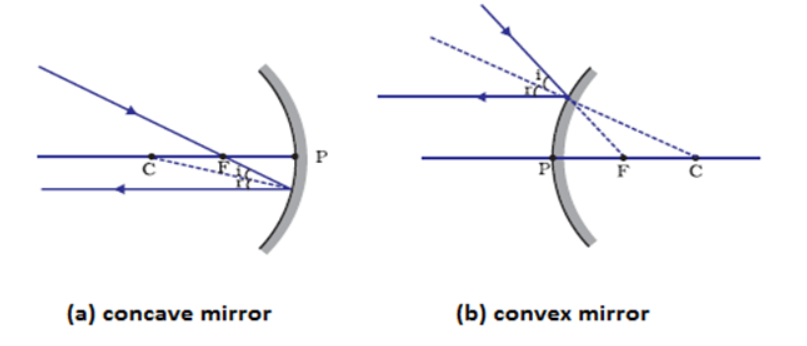
Rule 1: An incident light ray parallel to the principal axis, passes through the principal focus or appears to pass through the principal focus after reflection.
Rule 2: An incident light ray that passes through the principal focus or appears to pass through the principal focus, travel parallel to the principal axis after reflection.
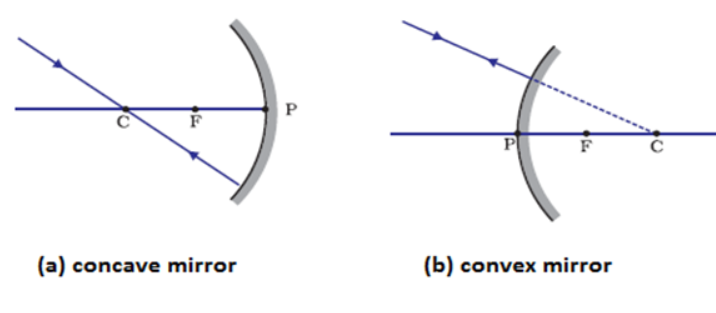
Rule 3: An incident light ray that passes through the center of curvature or appears to pass through the center of curvature, after reflection and retraces its initial path.
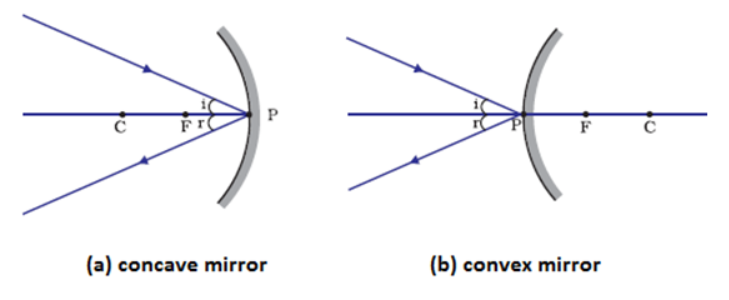
Rule 4: A ray incident obliquely to the principal axis towards the pole, P of the curved mirror (concave mirror and convex mirror) is reflected obliquely.
Note:
The incident and reflected rays always follow the laws of reflection at the point of incidence (P) making equal angles with the principal axis.
that passes through the center of curvature or appears to pass through the center of curvature, after reflection and retraces its initial path.
Reflection By Concave Mirrors
Incident Ray
Reflected Ray
Parallel to principal axis
Passes through focus
Passes through C
Retraces its path
Passes through focus
parallel to principal axis
Strikes the pole at an angle with principal axis
Makes the same angle with the principal axis.
Reflection by Convex Mirror
Incident Ray
Reflected Ray
Parallel to principal axis
Appears to pass through focus
Directed towards the focus
Appears to pass parallel to principal axis
Strikes the pole at an angle with principal axis
Makes the same angle with principal axis
Concave Mirror
Terms Associated With Concave Mirror
The geometric centre of a concave mirror is called its pole.
The centre of the sphere from which the concave mirror was cut is called the centre of curvature of the concave mirror.
The centre of curvature of the reflecting surface of a concave mirror is called the centre of curvature of the concave mirror.
The distance from any point on the concave mirror to its center of curvature is called the radius of curvature of the concave mirror.
An imaginary line passing through the center of curvature and the pole of the concave mirror is called the principal axis of the concave mirror.
The area of a concave mirror that is exposed to incident light is called the aperture of the concave mirror.
The length along the principal axis from the pole to the principal focus is called the focal length of the concave mirror.
If an object is placed close to a concave mirror such that the distance between the mirror and the object is less than its focal length, then a magnified and virtual image is formed.
This property of the concave mirror is used in many applications such as a dentist mirror to view the inner parts of the mouth clearly and a shaving mirror.
Concave mirrors converge the light incident on them and hence are called converging mirrors.
Image Formation by Concave Mirror
Location of an image of an object formed by a concave mirror by drawing the ray diagrams.
*We can locate the image of an object formed by a concave mirror by drawing the ray diagrams.
*The intersecting point of at least two reflections will give the position of image of the point object.
*The following rays can be used to draw the ray diagrams.
*A ray parallel to the principal axis of a concave mirror.
*A ray passing through the focus of the concave mirror
*A ray which is passing through the centre of curvature of a concave mirror
*A ray incident obliquely to the principal axis on a concave mirror.
Rules for Drawing Ray Diagrams in Spherical Concave Mirrors
A ray parallel to the principal axis of a concave mirror.
*A ray parallel to the principal axis of the concave mirror reflects through its focus.
A ray passing through the focus of the concave mirror.
*A ray passing through the focus of the concave mirror reflects parallel to the principal axis.
A ray which is passing through the centre of curvature of a concave mirror
*A ray which is passing through the centre of curvature of a concave mirror reflects back on the same path.
*A ray incident obliquely to the principal axis on a concave mirror.
A ray when incident obliquely to the principal axis on a concave mirror also reflects obliquely.
Concave Mirrors – Ray Diagrams
Depending on the position of the object in front of the concave mirror, the position, size and the nature of the image varies.
We can represent the images formed by a Concave Mirror using Ray Diagrams.
Object at infinity
A real, inverted, highly diminished image is formed at the focus, F, in front of the concave mirror.
Object beyond C
A real, inverted, diminished image is formed between C and F, in front of the concave mirror.
Object at C
A real, inverted, same sized image is formed at C, in front of the concave mirror.
Object between C and F
A real, inverted, enlarged image is formed beyond C, in front of the concave mirror.
Object at F
A real, inverted, highly enlarged image is formed at infinity, in front of the concave mirror.
Object between F and P
A virtual, erect and enlarged image is formed behind the concave mirror.
Image Formation by a Concave Mirror
Object Location
Image Location
Nature of Image
Infinity
At F
Real, InvertedHighly DiminishedMagnification<<1
Beyond C
Beyond F and C
Real, Inverted, Diminished Magnification<1
At C
At C
Real, Inverted, Equal to size of object Magnification=1
Between C and F
Beyond C
Real, Inverted, Magnified Magnification>1
At F
Infinity
Real, Inverted, Highly Magnified Magnification>>1
Between F and P
Behind the mirror
Virtual, Erect, Magnified, Magnification>1
Uses of Concave Mirrors
Concave mirrors are used as shaving mirrors to see a larger image of the face.
Dentists use concave mirrors to view a magnified view of the interior parts of the mouth.
ENT doctors use them for examining the internal parts of the ear, nose and throat.
They are used as reflectors in the headlights of vehicles, searchlights and in torch lights to produce a strong parallel beam of light.
Huge concave mirrors are used to focus sunlight to produce heat in solar furnaces.
Convex Mirror
A spherical mirror whose reflecting surface is curved outward is known as a convex mirror.
Terms Associated With Convex Mirror
The geometric centre of the curvature of the convex mirror is called its pole.
The centre of curvature of the reflecting surface of a convex mirror is called the centre of curvature of the convex mirror.
The distance from any point on the reflecting surface of a convex mirror to its centre of curvature is called radius of curvature of the convex mirror.
An imaginary line passing through the centre of curvature and the pole of the convex mirror is called the principal axis of the convex mirror.
The reflected rays, when projected backwards, appear to meet at a point on the principal axis. This point is called the principal focus. The length along the principal axis from the pole to the principal focus is called the focal length of the concave mirror.
The area of a convex mirror that is exposed to incident light is called the apertureof the convex mirror.
If the aperture of a convex mirror is small, then Convex mirrors, such as the rear view mirrors of cars and bikes, always form erect, virtual, and diminished images.
The location of the object does not affect the characteristics of the image formed by a convex mirror.
When an object approaches a convex mirror, the image formed by the mirror also approaches the mirror, but not proportionately. Because of this it is mentioned as “Objects seen in the mirror are closer than they appear” on the outside rear view mirrors of vehicles.
Image Formation by Concave Mirror
ray diagrams –
We can locate the image of an object formed by drawing a ray diagram.
The intersecting point of at least two reflections will give the position of image of the point object.
The two rays that can be used to draw the ray diagram are:
A ray parallel to the principal axis.
A ray parallel to the principal axis reflects
It passes through the focus in case of a concave mirror.
A ray parallel to the principal axis. On reflection it appears to diverge from principal focus after reflection in case of a convex mirror.
A ray passing through the focus of the concave mirror. On reflection it becomes parallel to the principal axis due to reflection.
A ray directed towards the focus of convex mirrors. On reflection it becomes parallel to the principal axis due to reflection.
A ray which is passing through the centre of curvature of a concave mirror. It reflects back on the same path.
A ray which is directed towards the centre of curvature of a convex mirror. It reflects back on the same path.
A ray when incident obliquely to the principal axis on a concave x mirror is also reflected obliquely.
A ray when incident obliquely to the principal axis on a convex mirror is also reflected obliquely.
Reflection by Convex Mirror
Incident Ray
Reflected Ray
Parallel to principal axis
Appears to pass through focus
Directed towards the focus
Appears to pass parallel to principal axis
Strikes the pole at an angle with principal axis
Makes the same angle with principal axis
Image Formed By A Convex Mirror
Irrespective of the position of the object, a virtual, erect and diminished image is formed between F and P, behind the convex mirror.
Uses of Convex Mirrors
Convex mirrors are used as:
rear view mirrors in automobiles and in ATM centres as it covers a wide area behind the driver.
reflectors in street light bulbs as it diverges light rays over a wide area.
Rear view mirrors of vehicles and the ones used.
Sign Convention for Spherical Mirrors
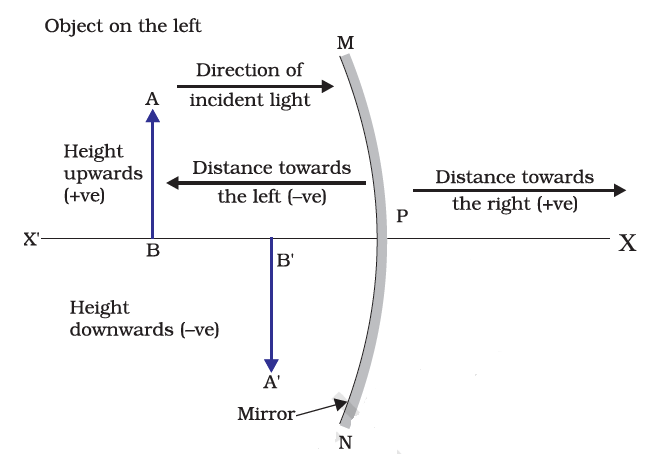
Object is always considered at the left side of the mirror
Distances measured in the direction of the incident ray are taken as positive.
Distances measured in the direction opposite to that of the incident rays are taken as negative.
All distances are measured from the pole of the mirror.
Distances measured along the y-axis above the principal axis are taken as positive.
Distances measured along the y-axis below the principal axis are taken as negative.
Table Showing Sign Convention
Type of Mirror
Object Distance, u
Image Distance, v
Focal length, f
Radius of Curvature, R
Height of the Object, hO
Height of the Image, hi
Real
Virtual
Real
Virtual
Concave mirror
–Ve
–Ve
+Ve
–Ve
–Ve
+Ve
–Ve
+Ve
Convex mirror
–Ve
Virtual image
+Ve
+Ve
+Ve
+Ve
Virtual image
+Ve
Mirror Formula
The relation between the focal length (f), object distance (u) and the image distance (v) is given by:
Magnification
The ratio of the height of the image in a spherical mirror, to the height of the object is called magnification (m)
Magnification,m = Height of Image, HHeight of Object, i= Image Distance, HObject Distance, i
The distance from the principal focus to the pole of the mirror is the focal length of the mirror and is equal to half the radius of curvature, which is the distance between the centre of curvature and the pole.
For a real image object distance (u) and the image distance (v) are negative and the magnification is negative.
If the magnification of an image is negative it does mean that the image is real and inverted.
On the other hand for a virtual image object distance (u) is negative and image distance (v) is positive and hence the magnification is positive, i.e., the image is erect.
If the magnification of an image is positive it does mean that the image is virtual and erect.
If the magnification is less than 1 The image formed is diminished in size.
If the magnification is more than 1 The image formed is magnified in size.
If the magnification is equal to 1 The image formed is equal to the object in size.
Convex mirrors diverge the light incident on them and hence they are called the diverging mirrors.
Due to this they always form diminished, virtual and erect images irrespective of the position of the object in front of them.
Thus, the magnification caused by these mirrors is always less than one.
The field of view for a convex mirror is greater than that for a plane mirror, the aperture being the same.
Hence, convex mirrors are used as rear-view mirrors in vehicles.
It is also installed behind automated teller machines as a security measure.
The field of view for a convex mirror is greater than that for a plane mirror, the aperture being the same.
Hence, convex mirrors are used as rear-view mirrors in vehicles. It is also installed behind automated teller machines as a security measure.
The images formed by convex mirrors are always diminished, virtual and erect, irrespective of the position of the object.
Differences Between Convex Mirror and Concave Mirror
Convex Mirror
Concave Mirror
Convex mirror is curved outwards.
1. Concave mirror is curved inwards.
The focal point of the convex mirror is behind the mirror.
2. The focal point of the concave mirror is in front of the mirror.
In convex mirrors the image is always virtual, upright and smaller than the object.
3. In the case of concave mirrors different types of images are formed on different locations of the object. The image is upside down (inverted) and far away but if we bring the object close to the mirror then the image will be larger and upright.
Convex mirrors are used in cars (as passenger-side mirrors since they provide upright and wide view), they are also used in camera phones, for safety measures there are also used in roads and driveways.Besides these convex mirrors are found in many hospitals, schools etc. as hallway safety mirrors.
4. Concave mirrors are used in telescopes. These are also used as make up and shaving mirrors since these provide larger images. Besides these concave mirrors are used by dentists and also used in headlights of cars, solar devices, satellite dishes etc.
Refraction Of Light At Plane Surfaces
Introduction
Light bends while traveling from one medium to another. Since the refraction of light occurs at the surface joining two media, the refraction is a surface phenomenon.
The bending of light when it travels from one medium into another is called refraction of light.
The reason for refraction of light is the change in speed of light.
The speed of light in an optically rarer medium is more than that in an optically denser medium.
Light rays passing from rarer to denser medium bends towards the normal. This makes the angle of incidence (angle between the incident ray and the normal at the point of incidence) more than that of the angle of refraction (angle between the normal and the refracted ray).
Light rays passing from denser to rarer medium bends away from the normal. This makes the angle of incidence (angle between the incident ray and the normal at the point of incidence) less than that of the angle of refraction (angle between the normal and the refracted ray).
The extent to which a light ray bends depends on the refrangibility of the ray with respect to the medium.
In other words, the extent to which a light ray bends depends on the refractive index of the respective medium.
The ratio of velocity of light in vacuum to that in a medium is termed as the absolute refractive index (m) of the medium or simply termed as the refractive index of the medium.
Refractive index (m) of the medium is the measure of the ability of light to get bent in the given medium.
Measuring the speed of light is difficult.
We can determine the refractive index using Snell’s law
According to Snell’s law,
The refraction of light obeys the following two laws:
The incident ray, the refracted ray and the normal at the point of incidence all lie in the same plane.
The ratio of the sine of the angle of incidence to the sine of the angle of refraction is a constant. This constant is called the index of refraction or refractive index.
Mathematically, (sin i)/(sin r)= (n2/n1) (Or)
(sin i)/(sin r)= (1n2), where (1n2), is the refractive index of the medium 2, in which the refracted ray travels, with respect to medium 1, in which the incident ray travels.
This law is credited to Willebrord Snell and is, therefore, called Snell’s law.
If wng is the refractive index of glass w.r.t. water, angbe the refractive index of glass w.r.t. air and anwbe the refractive index of water w.r.t. air ,then
wng= ang/anw
If the light ray retraces its path while traveling from denser to rarer, the angle of incidence is lesser than that of the refraction. This is the principle of reversibility.
The extent to which a light ray bends depends on the refrangibility of the ray with respect to the medium.
The ratio of velocity of light in vacuum to that in a medium is termed as the absolute refractive index (m) of the medium. Absolute refractive index (m) of the medium is the measure of the ability of light to get bent in the given medium.
Measuring the speed of light is difficult.
We can determine the refractive index using Snell’s law
According to Snell’s law,
Refraction of Light At A plane Surface
The bottom of a water glass appears to rise upwards when viewed normally. This is due to the vertical shift of the bottom of the glass, which takes place because of refraction.
Refraction of Light At Glass Slab
When a light ray, incident at an angle, passes through a glass slab, the emergent ray shifts laterally, known as lateral shift.
The lateral shift depends on the thickness and refractive index of the glass slab.
If the angle of incidence increases gradually, the angle of refraction also increases.
But, at a particular angle of incidence in the denser medium, the refracted ray emerges along the surface. That particular angle is known as the critical angle.
If the angle of incidence is greater than the critical angle, the ray undergoes Total Internal Reflection.
The formation of Mirages in deserts is due to total internal reflection of light.
n=cv
n=(Speed of light in vacuum)/( speed of light in the medium)
As light travels from one medium to another, the frequency of light does not change.
Lenses
A lens is a piece of transparent optical material with one or two curved surfaces to refract light rays.
The simplest lens has two spherical surfaces close enough together that we can neglect the distance between them. Such a lens is called a thin lens.
The two common types of lenses are Converging lens or Convex lens.
It should be noted that, if the above lenses are surrounded by a material with a refractive index greater than that of the lens, the convex lens gets converted into a concave lens and vice versa.
A lens may converge or diverge light rays to form an image.
Types of Lenses
A bi-convex lens is one with a surface that is bulged outwards on both the sides. It is generally referred to as a convex lens.
Another type of lens is a bi-concave lens that has two inward bent surfaces. It is generally referred to as a concave lens.
A Plano-convex lens has a convex surface on one side and a plane surface on the other.
A Plano-concave lens is the one that has a concave surface on one side and a plane surface on the other.
A concavo-convex lens has a concave surface on one side and a convex surface on the other.
Convex and concave lenses are important as they are more commonly used than the other types of lenses.
Terms Used for Lens
Center of Curvature: The center of the imaginary glass sphere of which the lens is a part, is called center of curvature.
Principal Axis: An imaginary line joining the centers of curvature of the two spheres, of which lens is a part, is called Principal Axis.
Optic Center: A point within the lens, where a line drawn through the diameter of lens meets the principal axis, is called the optic center.
Principal Focus for Convex Lens: It is a point on the principal axis of a convex lens, where parallel beams of light rays, traveling parallel to the principal axis, after passing through the lens actually meet.
Principal Focus for Concave Lens: It is a point on the principal axis of a concave lens, from where a parallel beam of light rays, traveling parallel to the principal axis, after passing through the lens, appears to come.
Focal Length: The distance between principal focus and optical centre is called focal length.
Aperture: The effective diameter of the lens through which refraction takes place is called aperture of lens.
Optic centre is a point on the axis of a lens such that any light ray passing through this point emerges without refraction.
• Principal focus is a point on the axis of a lens.
• Principal focus is also known as the focal point.
Spherical Lenses
Convex Lense
A lens in which both the surfaces are convex, is known as convex lens.
Since the convex lens converges the light incident on it. It is called the converging lens.
The convex lenses form different types of images depending on its relative position with respect to the position of the object in front of them.
Thus, the magnification produced by these lenses varies.
Concave Lense
A lens in which both the surfaces are concave, is known as a concave lens.
Since the concave lens diverges the light incident on it. It is called the diverging lens.
Due to this the concave lenses always form diminished, virtual and erect images irrespective of the position of the object in front of them.
Thus, the magnification produced by these lenses is always less than one.
Image Formation by Refraction Of Light Through Spherical Lenses
Behaviour of Light Rays Propagating Through a Convex Lens
Rules for Construction of Ray Diagrams for Convex Lens
Rule 1: All rays parallel to the
principal axis of a convex lens passes through the principal focus after refraction.
Rule 2: A ray of light passing through the focus of a convex lens becomes parallel to the principal axis after refraction.
Rule 3: A ray of light passing through the optical center of a convex lens passes un deviated after refraction.
Rule 4:
Note: A convex and a concave lens can be supposed to be made-up of prisms.
Image Formation by a Convex Lens
Object Location
Image Location
Nature of Image
Uses
Infinity
At F2
• Real• Inverted• Highly Diminished
Telescopes
Beyond 2F1
Between F2 and 2F2
• Real• Inverted• Diminished
In a camera, In eye while reading
At 2F1
At 2F2
• Real• Inverted• Equal to size of object
Photocopier
Between 2F1 and F1
Beyond 2F2
• Real• Inverted• Magnified
Projector, Microscope objective
At F1
Infinity
• Real• Inverted• Highly Magnified
Spotlights
Between F and O
On the same side of lens as the object
• Virtual• Erect• Magnified
Magnifying glass, eye lenses spectacles for short distances.
Concave Lens:
A lens, in which both the surfaces are concave, is known as a concave lens.
An image formed by a concave lens is always diminished due to the divergence of rays. This is why concave lenses are widely used to correct eye defects such as myopia.
A concave lens is also known as a diverging, reducing, negative and myopic or minus lens.
Behaviour of Light Rays Propagating Through a Concave Lens.
Behaviour of Light Rays Propagating Through a Concave Lens
Rules for Construction of Ray Diagrams for Concave Lens
Rule 1: All rays parallel to the principal axis of a concave lens diverge such that they are coming from the principal focus after refraction.
Rule 2: A ray of light directed towards the focus of a concave lens becomes parallel to the principal axis after refraction.
Rule 3: A ray of light passing through the optical center of a concave lens passes un deviated.
Note: A convex and a concave lens can be supposed to be made-up of prisms.
The lens formula defines the relationship between the focal length of the lens (f), the distance of the object from the optic center (u) and the distance of the image from the optic center (v):
Location and Characteristic of the Images Formed by a Concave Lens
Sign convention for spherical lenses:
All distances on the principal axis are measured from the optic center of the lens.
All distances measured above the principal axis are taken as positive. Thus, height of an object and that of an erect image are positive and all distances measured below the principal axis are taken as negative.
The distances measured in the direction of the incident light are taken as positive (+)
The distances measured in the direction opposite to that of the incident light are taken as negative (-).
To understand the parts of one whole (i.e. a unit) we represent by a block divided into 10 eaual parts means (1/10) th of a unit. (Scroll down to continue …)
Study Tools
Audio, Visual & Digital Content
Addition of Decimals: Decimalscan be added by writingthem with equal number of decimals places.Example: add 0.005,6.5 and 20.04.
Solution: Convert the given decimals as 0.005, 6.500 and 20.040. 0.005+ 6.500 + 20.040 = 26.545
Subtraction of Decimals: Decimalscan be subtracted by writingthem with equalnumber of decimalplaces.
Example: Subtract the given decimals as 5.674 and 12.500 12.500– 5.674 = 6.826
ComparingDecimals: Decimalsnumberscanbecompare The givendecimals have distinctwhole number part, so we compare wholenumber part only. The whole number part of 45.32 is greater than 35.69. Therefore, 45.32>35.69.
Using Decimals: Many dailylife problems can be solvedby converting different units of measurements such as money,length, weight, etc. in the decimal form.
Data: A collection of numbers gathered to give someinformation. Recording Data:Data can becollected from different sources. Pictograph: The representation of data through pictures of objects. It helps answer the questions onthe data ata glance. (Scroll down to continue …)
Study Tools
Audio, Visual & Digital Content
Bar Graph: Pictorial representation of numerical datain the formof bars (ractangles) of equal width and varying heights. We have seen that data is a collection of numbers gathered to give some information.
To get a particular information from the givendata quickly, thedata can be arranged ina tabular formusing tally marks. We learnt how a pictograph represents data in the formof pictures, objects or parts ofobjects.
We have also seen how to interpret a pictograph and answer the related questions.
We havedrawn pictographs using symbols to represent a certain number of items orthings.
We havediscussed how torepresent data byusing a bardiagram or abar graph.
Ina bar graph, bars of uniform width are drawn horizontally or vertically with equal spacing between them.
Thelength of eachbar gives therequired information.
To do this we also discussed the process of choosing a scale for the graph. For example, 1unit = 100students.
We havealso practised reading a given bargraph.
We have seen howinterpretations from thesame can bemade.
Hindi Version
Dig Deep
Topic Level Resources
Sub – Topics
Select A Topic
Topic:
Chapters Index
Select Another Chapter
[display-posts category=”CBSE 6 – Mathematics – Study – Premium” posts_per_page=”25″]
Perimeter is the length of the boundary of the geometric shape.
In other words the distance covered along theboundary forming aclosed figure whenyou go round the figure once.
(a) Perimeter of arectangle = 2 × (length + breadth) (b) Perimeter of a square = 4 × length ofits side. (Scroll down to continue …)
Study Tools
Audio, Visual & Digital Content
Mensuration
Perimeter is the length of the boundary of the geometric shape.
In other words the distance covered along theboundary forming aclosed figure whenyou go round the figure once.
(a) Perimeter of arectangle = 2 × (length + breadth)
(b) Perimeter of a square = 4 × length ofits side
(c) Perimeter of anequilateral triangle =3 × length of a side
(d) Perimeter of a regular pentagon has five equal sides = 5 × length of a sides Figures in which all sides and angles are equal are called regular closed figures.
The amount of surface enclosed by a closed figure is called its area. To calculate the area of a figure using a squared paper, the following conventions are adopted :
(a) Ignore portions ofthe area thatare less thanhalf a square.
(b) If more than half a square is in a region. Count it as one square
(c) If exactly half the square is counted, take its area as
Area of a rectangle = length × breadth Area of a square = side × side
Hindi Version
Dig Deep
Topic Level Resources
Sub – Topics
Select A Topic
Topic:
Chapters Index
Select Another Chapter
[display-posts category=”CBSE 6 – Mathematics – Study – Premium” posts_per_page=”25″]
Ratio and ProportionComparison By Taking Difference | Speed Notes
Notes For Quick Recap
CHAPTER 12Ratio and ProportionComparison by taking difference: For comparing quantities of thesame type, wecommonly use themethod of taking difference between thequantities. Some times thecomparison by difference does not makebetter sense thanthe comparison by division. (Scroll down to continue)
Study Tools
Audio, Visual & Digital Content
Comparison by Division: In many situations, a more meaningful comparison between quantities is made byusing division, i.e.. by seeing how many times one quantity is to the other quantity. This method is known ascomparison by ratio. The comparison of two numbers or quantities bydivision is knownas the ratio. Symbol ‘:’is used todenote ratio. For comparison by ratio, thetwo quantities mustbe in thesame unit. Ifthey are not,they should beexpressed in thesame unit before the ratio istaken. For example, Isha’s weight is25 kg andher father’s weight is 75 kg.We say thatIsha’s father’s weight and Isha’s weight are in theratio 3 : 1
Hindi Version
Dig Deep
Topic Level Resources
Sub – Topics
Select A Topic
Topic:
Chapters Index
Select Another Chapter
[display-posts category=”CBSE 6 – Mathematics – Study – Premium” posts_per_page=”25″]
We haveseen that there are times whenwe need touse numbers witha negative sign. This is when we want to go below zero on the number line. These are called negative numbers. Some examples of their use can be in temperature scale, water level in lake or river, level of oil in tank etc. (Scroll down to continue …)
Study Tools
Audio, Visual & Digital Content
They are also used to denote debit account or outstanding dues. The collection of numbers…, – 4, – 3, – 2, – 1, 0, 1, 2, 3, 4, … is called integers. So, – 1,– 2, – 3, – 4, … called negative numbers are negative integers and 1, 2, 3, 4, … called positive numbers are the positive integers. We havealso seen howone more thangiven number givesa successor andone less than given number gives predecessor. We observe that (a) When we havethe same sign,add and putthe same sign. (i) When two positive integers are added, we get a positive integer [e.g.. (+3) + (+2) = + 5]. (ii) When two negative integers are added, we get a negative integer [e.g.. (–2) +(–1)= – 3]. (b) When one positive and one negative integers are added we subtract them as whole numbers by considering thenumbers without their sign and thenput the signof the bigger number with the subtraction obtained. The bigger integer is decided by ignoring thesigns of theintegers [e.g.. (+4)+ (–3) =+ 1 and(–4) + (+3)= – 1]. (c) The subtraction ofan integer isthe same asthe addition ofits additive inverse. We have shownhow addition andsubtraction of integers can also beshown on a number line.
Hindi Version
Dig Deep
Topic Level Resources
Sub – Topics
Select A Topic
Topic:
Chapters Index
Select Another Chapter
[display-posts category=”CBSE 6 – Mathematics – Study – Premium” posts_per_page=”25″]
What havewe discussed? A fraction is a number representing a partof a whole. The whole maybe a single object or agroup of objects. (Scroll down to continue …)
Study Tools
Audio, Visual & Digital Content
Whenexpressing a situation of counting partsto write a fraction, itmust be ensured that allparts are equal.
In5/7, 5 iscalled the numerator and 7 iscalled the denominator.
Fractions can beshown on a number line.
Every fraction has a point associated with it onthe number line.
In a proper fraction, the numerator is less than the denominator.
Thefractions, where the numerator is greater than the denominator are called improper fractions.
An improper fraction can be written as a combination of a whole and a part, and such fraction then called mixed fractions.
Each proper or improper fraction has many equivalent fractions.
To find an equivalent fraction of a given fraction, we may multiply or divide boththe numerator andthe denominator ofthe given fraction by the samenumber.
A fraction issaid to bein the simplest (or lowest) formif its numerator and the denominator haveno common factor except 1.
Hindi Version
Dig Deep
Topic Level Resources
Sub – Topics
Select A Topic
Topic:
Chapters Index
Select Another Chapter
[display-posts category=”CBSE 6 – Mathematics – Study – Premium” posts_per_page=”25″]
Whole Numbers The numbers 1,2, 3, ……which we use for counting are known as natural numbers. If you add 1 to a natural number, we get its successor. If you subtract 1 from a natural number, you get its predecessor. (Scroll down to continue …)
Study Tools
Audio, Visual & Digital Content
Every natural number has a successor. Every natural number except 1 has a predecessor.
Whole Numbers
Whole numbers are formed by adding zero to the collection of natural numbers. Hence, the set of whole numbers includes 0, 1, 2, 3, and so on.
Key Properties of Whole Numbers:
Successors and Predecessors:
Every whole number has a successor. For example:
The successor of 0 is 1.
The successor of 1 is 2.
The successor of 2 is 3.
Every whole number except zero has a predecessor. For example:
The predecessor of 1 is 0.
The predecessor of 2 is 1.
The predecessor of 3 is 2.
Relationship with Natural Numbers:
All natural numbers (1, 2, 3, …) are whole numbers, but not all whole numbers are natural numbers since whole numbers include 0.
Number Line Representation:
Whole Number Line
To visualize whole numbers, we can draw a number line starting from 0:
Mark points at equal intervals to the right: 0, 1, 2, 3, …
This number line allows us to carry out operations:
Addition: Moving to the right (e.g., 1 + 2 = 3).
Subtraction: Moving to the left (e.g., 3 – 1 = 2).
Multiplication: Making equal jumps (e.g., 2 × 3 means jumping twice the distance of 2, reaching 6).
Division: Although division can be tricky, it involves partitioning. For example, 6 ÷ 2 means splitting 6 into 2 equal parts, resulting in 3.
Closure Properties:
Adding two whole numbers always results in a whole number:
Examples:
2 + 3 = 5
0 + 4 = 4
1 + 1 = 2
Multiplying two whole numbers also results in a whole number:
Examples:
2 × 3 = 6
0 × 5 = 0
1 × 4 = 4
Whole numbers are closed under subtraction only if the result is non-negative:
Examples:
2 – 1 = 1
5 – 3 = 2
3 – 3 = 0
Yet, if the result is negative, they are not closed under subtraction:
Example: 2 – 3 = -1 (not a whole number).
So, the whole numbers are not not closed under subtraction.
Division by whole numbers is defined only when the divisor is not zero, and the result is a whole number:
Examples:
6 ÷ 2 = 3
8 ÷ 4 = 2
0 ÷ 5 = 0
Division by zero is undefined (e.g., 5 ÷ 0).
So, the whole numbers are not not closed under division.
Identity Elements:
Zero acts as the identity for addition:
Example: 5 + 0 = 5.
The whole number 1 acts as the identity for multiplication:
Example: 3 × 1 = 3.
Commutative and Associative Properties:
Addition is commutative:
Examples:
2 + 3 = 3 + 2
1 + 4 = 4 + 1
0 + 5 = 5 + 0
Multiplication is also commutative:
Examples:
2 × 3 = 3 × 2
1 × 4 = 4 × 1
0 × 5 = 5 × 0
Both addition and multiplication are associative:
Examples for addition:
(1 + 2) + 3 = 1 + (2 + 3)
(0 + 4) + 1 = 0 + (4 + 1)
(2 + 2) + 2 = 2 + (2 + 2)
Examples for multiplication:
(1 × 2) × 3 = 1 × (2 × 3)
(0 × 4) × 1 = 0 × (4 × 1)
(2 × 2) × 2 = 2 × (2 × 2)
Distributive Property:
Multiplication distributes over addition:
Example: 2 × (3 + 4) = 2 × 3 + 2 × 4.
Understanding these properties helps simplify calculations. It enhances our grasp of numerical patterns. These patterns are not only interesting but also practical for mental math.
Hindi Version
Dig Deep
Topic Level Resources
Sub – Topics
Select A Topic
Topic:
Chapters Index
Select Another Chapter
[display-posts category=”CBSE 6 – Mathematics – Study – Premium” posts_per_page=”25″]
We have discussed multiples, divisors, factors and have seenhow to identify factors and multiples. We have discussed and discovered thefollowing: (a) A factor of a number is an exactdivisor of thatnumber. (Scroll down to continue …)
Study Tools
Audio, Visual & Digital Content
(b) Every number is a factor of itself. 1 is a factor ofevery number.
(c) Every factor ofa number isless than or equal tothe given number.
(d) Every number isa multiple ofeach of itsfactors.
(e) Every multiple ofa given number is greater thanor equal tothat number.
(f) Every number is a multiple of itself.
We have learnt that – (a) The number otherthan 1, withonly factors namely 1 and thenumber itself, isa prime number. Numbers that have more than two factors are called composite numbers. Number 1is neither prime nor composite.
(b) The number 2is the smallest prime number andis even. Every prime number other than 2 isodd.
(c) Two numbers withonly 1 asa common factor are called co-prime numbers.
(d) If a number is divisible byanother number thenit is divisible by each of the factors of that number.
(e) A number divisible by two co-prime numbers is divisible by their product also.
We have discussed how we can find just by looking at a number, whether it is divisible by small numbers 2,3,4,5,8,9 and 11.
We have explored the relationship between digits of thenumbers and theirdivisibility by different numbers.
(a) Divisibility by 2,5and 10 canbe seen byjust the lastdigit.
(b) Divisibility by 3and 9 ischecked by finding the sum ofall digits.
(c) Divisibility by 4 and 8is checked bythe last 2and 3 digits respectively.
(d) Divisibility of11 is checked by comparing thesum of digits at odd andeven places.
We have discovered that if twonumbers are divisible by a number then their sum and difference are also divisible by that number.
We have learnt that – (a) The Highest Common Factor (HCF) of two ormore given numbers is the highest of their common factors.
(b) The Lowest Common Multiple (LCM) of two ormore given numbers is the lowest of their common multiples.
Hindi Version
Dig Deep
Topic Level Resources
Sub – Topics
Select A Topic
Topic:
Chapters Index
Select Another Chapter
[display-posts category=”CBSE 6 – Mathematics – Study – Premium” posts_per_page=”25″]
Geometry is a branch of mathematics concerned with properties of space such as the distance, shape, size, and relative position of figures. A mathematician who works in the field of geometry is called a 🎉geometer. (Scroll down to continue …)
Study Tools
Audio, Visual & Digital Content
Basic Geometrical Ideas | Speed Notes
Notes For Quick Recap
Geometry
Geometry is a branch of mathematics concerned with properties of space such as the distance, shape, size, and relative position of figures. A mathematician who works in the field of geometry is called a 🎉geometer.
Space
Space: space refers to a set of points that form a particular type of structure.
Plane
A plane is a flat surface that extends infinitely in all directions
Point
Point is an exact position or location in space with no dimensions.
Mathematically, a point is defined as a circle with zero radius.
Since it is not possible its is represented by a very small dot.
A point is usually represented by a capital letter.
In mathematical terms, pont is a cirlce with no radius. It does mean that a very very small circle.
A point determines a location. It is usually denoted by a capital letter.
Lines And Its Types
Ray
A Ray is a straight path that stars at a point and extends infinitely in one direction.
Note: A ray is a portion of line starting at a point and extends in one direction endlessly. A ray has only one endpoint (Initial point).
Line or Straight Line
A line is a straight path that extends infinitely in two opposite directions. It can be treated as a combination of two rays starting from the same point but extending in the opposite directions.
Note: A line has no end points.
Line Segment:
A line segment is the part of a line between two points. (Segment means part).
The length of a line segment is the shortest length between two end points.
The line segment has two end points. Note: A line Segment has two endpoints. (both Initial and end points). (Scroll down to continue …).
Intersecting Lines and Non-intersecting Lines
Intersecting And Parallel Lines
Parallel Lines
The lines which never cross each other at any point are called Parallel lines or Non-intersecting lines.
In other words, lines that are always the same distance apart from each other and that never meet are called Parallel lines Or Non-intersecting lines.
The perpendicular length between two lines is the distance between parallel lines.
Note: Parallel lines do not have any common point.
Intersecting Lines
The lines which cross (meet) each other at a point are called Intersecting Lines or non-parallel lines.
Intersecting lines meet at only one point.
Angle
An angle is made up of two rays starting from a common end point.
An angle leads to three divisions of a region:
On the angle, the interior of the angle and the exterior of the angle.
Curve
In geometry, a curve is a line or shape that is drawn smoothly and continuously in a plane with bends or turns.
In other words, Curve is a drawing (straight or non-straight) made without lifting the pencil may be called a curve.
Mathematicians define a curve as any shape that can be drawn without lifting the pen.
In Mathematics, A curve is a continuous and smooth line that is defined by a mathematical function or parametric equations.
Note: In this sense, a line is also a curve.
Types of Curves
Simple Or Open And Closed Curves
Cureves are two types based on intersection (crossing). They are (i) Simple or Open curve (ii) Closed curve.
Simple Curve
Simple or open curve is a curve that does not cross (intersect) itself.
Closed Curve
Closed curve is a curve that crosses (intersects) itself.
Concave And Convex Curves
Curves are of two types. They are concave curve and convex curve.
Concave Curve:
A curve is concave is a curve that curves inward, resembling a cave.
Examples:
– The interior of a circle.
– The graph of a concave function like y = -x2.
Convex Curves:
A curve is convex if it curves outward.
Examples:
– The exterior of a circle.
– The graph of a convex function like y = x2.
Polygon
A polygon is a simple closed figure formed by the line segments.
Types of Polygons
Polygons are classified into two types on the basis of interior angles: as (i) Convex polygon (ii) Concave polygon.
(a) Concave Polygon:
A concave polygon is a simple polygon that has at least one interior angle, that is greater than 1800 and less than 3600 (Reflex angle).
And at Least one diagonal lies outside of the closed figure.
Atlest one diagonal lies outside of the polygon.
b. Convex Polygon:
A convex polygon is a simple polygon that has at least no interior angle that is greater than 1800 and less than 3600 (Reflex angle).
And no diagonal lies outside of the closed figure.
In this case, the angles are either acute or obtuse (angle < 180 o).
Regular And Irregular Polygon
On the basis of sides, there are two types of polygons as Regular Polygon and Irregular Polygon
(a) Regular Polygon:
A convex polygon is called a regular polygon, if all its sides and angles are equal as shown in the following figures.
Each angle of a regular polygon of n-sides =
Part of Polygon
(i) Sides Of The Polygon
The line segments of a polygone are called sides of the polygon.
(ii) Adjacent Sides Of Polygon
Adjacent sides of a polygon are thesides of a polygon with a common end point.
(iii) Vertex Of Polygon
Vertext of a polygon is a point at which a pair of sides meet.
(iv) Adjacent Vertices
Adjacent vertices of polygon are the end points of the same side of the polygon.
(v) diagonal
Diagonal of a polygone is a line segment that joins the non-adjacent vertices of the polygon.
Triangle
A triangle is a three-sided polygon.
In other terms triangle is a three sided closed figure.
Quadrilateral
A quadrilateral is a four-sided polygon. (It shouldbe named cyclically).
In any
similar relations exist for the other three angles.
Circle And Its Parts
A circle is the path of a point moving at the same distance from a fixed point.
Centre Of Circle
Centre Of Circle is a point that is equidistant from any point on the boundary of the circle.
In other words the centre of the circles is a centre point of the circle.
Radius Of Circle
Radius of circle is the distance between the centre of the circle and any point on the boundary of the circle.
Circumference Of Circle
Circumference of circle is the length of the boundary of the circle.
Chord Of Circle
A chord of a circle is a line segment joining any two points on the circle.
A diameter is a chord passing throughthe Centre of the circle.
Sector Of Circle
A sector is the region in the interior of a circle enclosed by an arc on one side and a pair of radii on the other two sides.
Segment Of Circle
A segment of a circle is a region in the interior of the circle enclosed by an arc and a chord.
The diameter of a circle divides it into two semi-circles.
The diameter of a circle divides it into two semi-circles.
Hindi Version
Dig Deep
Topic Level Resources
Sub – Topics
Select A Topic
Topic:
Chapters Index
Select Another Chapter
[display-posts category=”CBSE 6 – Mathematics – Study – Premium” posts_per_page=”25″]
The distance betweenthe end pointsof a line segment is its length. A graduatedruler and the divider are useful to compare lengthsof line segments. When a hand of a clock moves from one position to another position we have an examplefor an angle. (Scroll down to continue …)
Study Tools
Audio, Visual & Digital Content
One full turn of the hand is 1 revolution.
A right angle is ¼ revolution and a straight angle is ½ a revolution. We use a protractor to measure the size of an angle in degrees.
The measure of a right angle is 90° and hence that of a straight angle is 180°.
An angle is acute if its measure is smaller than that of a right angle and is obtuseif its measure is greaterthan that of a right angle and less than a straightangle.
A reflex angle is largerthan a straight angle.
Two intersecting lines are perpendicular if the anglebetween them is 90°.
The perpendicular bisector of a line segmentis a perpendicular to the line segmentthat divides it into two equal parts.
Triangles can be classified as follows based on their angles:
Triangles can be classified as follows based on the lengths of their sides:
Polygons are namedbased on theirsides.
Quadrilaterals are furtherclassified with reference to their properties.
·We see aroundus many three dimensional shapes.Cubes, cuboids, spheres,
cylinders, cones,prisms and pyramidsare some of them.
Hindi Version
Dig Deep
Topic Level Resources
Sub – Topics
Select A Topic
Topic:
Chapters Index
Select Another Chapter
[display-posts category=”CBSE 6 – Mathematics – Study – Premium” posts_per_page=”25″]
Congruence: The relation of two objects being congruent is called congruence. (Scroll down to continue …)
Study Tools
Audio, Visual & Digital Content
Chapter – 7
Congruence of Triangles
SSS Congruence of two triangles: Under a given correspondence, two triangles are congruent if the three sides of the one are equal to the three corresponding sides of the other.
SAS Congruenceof two triangles: Under a given correspondence, two triangles are
congruent if two sides and the angleincluded between them in one of the triangles are equal to the corresponding sides and the angle included between them of the other triangle.
ASA Congruence of two triangles: Under a given correspondence, two triangles are congruent if two anglesand the side included betweenthem in one of the triangles are equal to the corresponding angles and the side included between them of the other triangle.
RHS Congruence of two right-angled triangles: Under a given correspondence, two right-angled triangles are congruent if the hypotenuse and a leg of one of the triangles are equal to the hypotenuse and the corresponding leg of the other triangle.
There is no such thing as AAA Congruence of two triangles: Two triangles with equal corresponding angles need not be congruent. In such a correspondence, one of them can be an enlarged copy of the other.
(They would be congruent only if they are exact copies of one another).
The circle, thesquare, the rectangle, the quadrilateral and the triangle are examples of plane figures; the cube, the cuboid, the sphere, the cylinder, the cone and the pyramid areexamples of solid shapes.(Scroll down to continue …)
Study Tools
Audio, Visual & Digital Content
Plane figures areof two-dimensions (2-D) and the solid shapes are of three- dimensions (3-D). The corners of a solid shape are called its vertices; theline segments ofits skeleton areits edges; and itsflat surfaces areits faces. A net is a skeleton-outline of a solid that can be folded to make it. The same solid can haveseveral types ofnets. Solid shapes can be drawn on a flat surface (like paper) realistically. We call this 2-D representation of a 3-Dsolid. Two types ofsketches of asolid are possible: (a) An oblique sketch does nothave proportional lengths. Still it conveys all important aspects of the appearance of the solid. (b) An isometric sketch is drawn on an isometric dot paper, a sample of which isgiven at theend of thisbook. In an isometric sketch of the solidthe measurements kept proportional. Visualising solidshapesis a veryuseful skill. Youshould be ableto see ‘hidden’ parts of thesolid shape. Different sections of a solid can be viewed in many ways: (a) One way is to viewby cutting or slicing the shape, whichwould result in the cross- section of thesolid. (b) Another way isby observing a 2-D shadow of a 3-Dshape. (c) A third wayis to lookat the shapefrom different angles; the front-view, theside- view and thetop view canprovide a lotof information aboutthe shape observed.
19. When a grouping symbol preceded by ‘ sign is removed or inserted, thenthe sign of eachterm of thecorresponding expression ischanged (from ‘ + ‘ to ‘−’ and from‘− ‘ to + ‘).
Hindi Version
Dig Deep
Topic Level Resources
Sub – Topics
Select A Topic
Topic:
Chapters Index
Select Another Chapter
[display-posts category=”CBSE 7 – Mathematics – Study – Premium” posts_per_page=”25″]
Exponents are used to express large numbers in shorter form to make them easy to read, understand, compare and operate upon. (Scroll down to continue …)
Study Tools
Audio, Visual & Digital Content
Expressing Large Numbers in the Standard Form: Any number can be expressed as a decimal number between 1.0 and 10.0 (including 1.0) multiplied by a power of 10. Such form of a number is called its standard form or scientific motion. Very large numbers are difficult to read, understand, compare and operate upon. To make all these easier, we use exponents, converting many of the large numbers in a shorter form. The following are exponential forms of some numbers?
Here, 10, 3 and 2 are the bases, whereas 4, 5 and 7 are their respective exponents. We also say, 10,000 is the 4th power of 10, 243 is the 5th power of 3, etc. Numbers in exponential form obey certain laws, which are: For any non-zero integers a and b and whole numbers m and n,
(g) (–1) even number = 1 (–1) odd number = – 1
Hindi Version
Dig Deep
Topic Level Resources
Sub – Topics
Select A Topic
Topic:
Chapters Index
Select Another Chapter
[display-posts category=”CBSE 7 – Mathematics – Study – Premium” posts_per_page=”25″]
A closed plane figure bounded by three linesegments. The six elements of a triangle are its three angles and thethree sides. The line segment joining a vertex of a triangle to the mid point of its opposite side is called a medianof the triangle. (Scroll down to continue …)
Study Tools
Audio, Visual & Digital Content
Notes For Quick Recap
A closed plane figure bounded by three linesegments. The six elements of a triangle are its three angles and thethree sides. The line segment joining a vertex of a triangle to the mid point of its opposite side is called a medianof the triangle. (Scroll down to continue …)
Triangle:
A closed plane figure bounded by three line segments is called Triangle.
The six elements of a triangle are its three angles and the three sides. The line segment joining a vertex of a triangle to the midpoint of its
Median:
The opposite side is called the median of the triangle.
A triangle has three medians.
Altitude of the triangle:
The perpendicular line segment from vertex of a triangle to its opposite sides is called an altitude of the triangle.
A triangle has3 altitudes.
Type of triangle based onSides:Equilateral:
A triangle is said to be equilateral, if each one of its sides has the same length. In An equilateral triangle, each angle measures 60°.
Isosceles Triangle:
A triangle is said to be isosceles, if atleast any two of its sides are of same length. The non-equal side of an isosceles triangle is called its base; the base angles of an isosceles triangle have equal measure.
Scalene Triangle:
A triangle having all sides of different lengths. It has no two angles equal.
Property of the lengths of sides of a triangle:
The sum of the lengths of any two sides of a triangle is greater than the length of the third side. The difference between the lengths of any two sides is smaller than the length of the third side. This property is useful to know if it is possible to draw a triangle when the lengths of the three sides are known.
Types of Triangle based on Angles:
(i) Right Angled Triangle:
A triangle one of whose angles measures
(ii) Obtuse Angled Triangle:
A triangle one of whose angles measures more than
(iii) Acute Angled Triangle:
A triangle each of whose angles measures less than In a right angled triangle, the side opposite to the right angle is called the hypotenuse and the other two sides are called its legs.
Pythagoras property:
In a right-angled triangle, the square on the hypotenuse = the sum of the squares on its legs.If a triangle is not right-angled, this property does not hold good. Thisproperty is useful to decide whether a given triangle is right-angled
or not.
Exterior angle of a triangle:
An exterior angle of a triangle is formed, when a side of a triangle is produced. At each vertex, you have two ways of forming an exterior angle.
A property of exterior angles:
The measure of any exterior angle of a triangle is equal to the sum of the measures of its interior opposite angles.
The angle sum property of a triangle:
The total measure of the three angles of a triangle is 180°.
Property of the Lengths of Sides of a Triangle:
The sum of the lengths of any two sides of a triangle is always greater than the length of the third side. The difference of the lengths of any two sides of a triangle is always smaller than the length of the third side.
Important Formulas – TheTriangles and its Properties
1. A triangle is a figure made up by three line segments joining, in pairs, three non-collinear points. That is, if A, B, C are three non-collinear points, the figure formed by three line segments AB,BC and CA is called a triangle with vertices A, B, C.
2. The three line segments forming a triangle are called the sides of the triangle.
3. The three sides and three angles of a triangle are together called the six parts or elements of the triangle.
4. A triangle whose two sides are equal, is called an isosceles triangle.
5. A triangle whose all sides are equal, is called an equilateral triangle.
6. A triangle whose no two sides are equal, is called a scalene triangle.
7. A triangle whose all the angles are acute is called an acute triangle.
8. A triangle whose one of the angles is a right angle is called a right triangle.
9. A triangle whose one of the angles is an obtuse angle is called an obtuse triangle.
10. The interior of a triangle is made up of all such points P of the plane, as are enclosed by the triangle.
11. The exterior of a triangle is that part of the plane which consists of those points Q, which are neither on the triangle nor in its interior.
12. The interior of a triangle together with the triangle itself is called the triangular region.
13. The sum of the angles of a triangle is two right angles or 180°.
14. If a side of a triangle is produced, the exterior angle so formed is equal to the sum of the interior opposite angles.
15. In any triangle, an exterior angle is greater than either of the interior opposite angles.
16. The sum of any two sides of a triangle is greater than the third side.
17. In a right triangle, if a, b are the lengths of the sides and c that of the hypotenuse, then
18. If the sides of a triangle are of lengths a, b and c such that
then the triangle is right-angled and the side of length c is the hypotenuse.
19. Three positive numbers a, b, c in this order are said to form a Pythagorean triplet, if
Triplets (3, 4, 5) (5, 12,13), (8, 15, 17), (7,24, 25) and (12, 35,37) are somePythagorean triples.
Hindi Version
Dig Deep
Topic Level Resources
Sub – Topics
Select A Topic
Topic:
Chapters Index
Select Another Chapter
[display-posts category=”CBSE 7 – Mathematics – Study – Premium” posts_per_page=”25″]
Comparing Quantities: Weare often requiredto compare two quantities, in our dailylife. They may be heights, weights, salaries, marks etc. To compare two quantities, their units must be the same.
We are often required to compare two quantities in our daily life. They may be heights, weights,salaries, marks etc. (Scroll down to continue …)
Study Tools
Audio, Visual & Digital Content
While comparing heights of two persons with heights150 cm and 75 cm, we write it as the ratio 150 : 75 or 2 : 1.
Ratio: A ratio compares two quantities using a particular operation.
Percentage: Percentage are numerators of fractions with denominator 100. Percent is represent by the symbol% and means hundredth too.
Two ratios can be compared by converting them to like fractions. If the two fractions are equal,we say the two given ratios are equivalent.
If two ratios are equivalent then the four quantities are said to be in proportion. For example, the ratios 8 : 2 and 16 : 4 are equivalent therefore 8, 2, 16 and 4 are in proportion.
A way of comparing quantities is percentage. Percentages are numerators of fractions with denominator 100. Per cent means per hundred. For example 82% marks means
82 marks out of hundred.
Percentages are widely used in our daily life,
(a) We have learnt to find exact number when a certain per cent of the total quantity is given.
(b) When parts of a quantityare given to us as ratios, we have seen how to convert
them to percentages.
(c) The increase or decrease in a certainquantity can also be expressed as percentage.
(d) The profit or loss incurredin a certain transaction can be expressedin terms of percentages.
(e) While computing intereston an amount borrowed, the rate of interest is given in terms of per cents. For example, ` 800 borrowed for 3 years at 12% per annum. Simple Interest:Principal means the borrowed money.
The extra money paid by borrower for using borrowedmoney for given time is called interest(I).
The period for which the money is borrowed is called ‘TimePeriod’ (T).
Rate of interestis generally given in percentper year.
Interest, I = PTR/100
Total money paid by the borrower to the lenderis called the amount.
Hindi Version
Dig Deep
Topic Level Resources
Sub – Topics
Select A Topic
Topic:
Chapters Index
Select Another Chapter
[display-posts category=”CBSE 7 – Mathematics – Study – Premium” posts_per_page=”25″]