An equation isa condition ona variable suchthat two expressions in the variable should have equalvalue.
Thevalue of thevariable for whichthe equation issatisfied is called the solution ofthe equation.
An equation remains the same if the LHSand the RHSare interchanged. (Scroll down to continue …)
Study Tools
Audio, Visual & Digital Content
In case ofthe balanced equation, if we add the same number to both thesides, or subtract the same number from both the sides,
or
multiply both sidesby the same number, or divide both sidesby the samenumber, the balance remains un disturbed,
i.e.,the value of the LHS remains equal to the value of the RHS The above property gives a systematic method of solving an equation.
We carry out a series of identical mathematical operations on the two sides of the equation in such a waythat on oneof the sides we get justthe variable. Thelast step isthe solution of the equation.
Transposing means moving to the other side.
Transposition of a number has the same effect as adding same number to (or subtracting the same number from) both sides of the equation.
Whenyou transpose a number fromone side ofthe equation tothe other side, you change itssign.
For example, transposing +3 fromthe LHS tothe RHS in equation x + 3 = 8 gives x = 8 – 3 (= 5).
We can carry out the transposition of an expression in thesame way as the transposition of a number.
We havelearnt how to construct simple algebraic expressions corresponding to practical situations.
Wealso learnt how,using the technique of doing thesame mathematical operation (for example adding the samenumber) on bothsides, we could build an equation starting fromits solution.
Further, we also learnt that we could relate a given equation tosome appropriate problem/puzzlefrom the equation. practical situation and build a practical word.
Hindi Version
Dig Deep
Topic Level Resources
Sub – Topics
Select A Topic
Topic:
Chapters Index
Select Another Chapter
[display-posts category=”CBSE 7 – Mathematics – Study – Premium” posts_per_page=”25″]
A closed plane figure bounded by three linesegments. The six elements of a triangle are its three angles and thethree sides. The line segment joining a vertex of a triangle to the mid point of its opposite side is called a medianof the triangle. (Scroll down to continue …)
Study Tools
Audio, Visual & Digital Content
Triangle:
A closed plane figure bounded by three line segments is called Triangle.
The six elements of a triangle are its three angles and the three sides. The line segment joining a vertex of a triangle to the midpoint of its
Median:
The opposite side is called the median of the triangle.
A triangle has three medians.
Altitude of the triangle:
The perpendicular line segment from vertex of a triangle to its opposite sides is called an altitude of the triangle.
A triangle has3 altitudes.
Type of triangle based onSides:
Equilateral Triangle:
A triangle is said to be equilateral, if each one of its sides has the same length. In An equilateral triangle, each angle measures 60°.
Isosceles Triangle:
A triangle is said to be isosceles, if atleast any two of its sides are of same length. The non-equal side of an isosceles triangle is called its base; the base angles of an isosceles triangle have equal measure.
Scalene Triangle:
A triangle having all sides of different lengths. It has no two angles equal.
Property of the lengths of sides of a triangle:
The sum of the lengths of any two sides of a triangle is greater than the length of the third side. The difference between the lengths of any two sides is smaller than the length of the third side. This property is useful to know if it is possible to draw a triangle when the lengths of the three sides are known.
Types of Triangle based on Angles:
(i) Right Angled Triangle:
A triangle one of whose angles measures
(ii) Obtuse Angled Triangle:
A triangle one of whose angles measures more than
(iii) Acute Angled Triangle:
A triangle each of whose angles measures less than In a right angled triangle, the side opposite to the right angle is called the hypotenuse and the other two sides are called its legs.
Pythagoras Property:
In a right-angled triangle, the square on the hypotenuse = the sum of the squares on its legs.If a triangle is not right-angled, this property does not hold good. Thisproperty is useful to decide whether a given triangle is right-angled
or not.
Exterior angle of a triangle:
An exterior angle of a triangle is formed, when a side of a triangle is produced. At each vertex, you have two ways of forming an exterior angle.
A property of exterior angles:
The measure of any exterior angle of a triangle is equal to the sum of the measures of its interior opposite angles.
The angle sum property of a triangle:
The total measure of the three angles of a triangle is 180°.
Property of the Lengths of Sides of a Triangle:
The sum of the lengths of any two sides of a triangle is always greater than the length of the third side. The difference of the lengths of any two sides of a triangle is always smaller than the length of the third side.
Important Formulas – TheTriangles and its Properties
1. A triangle is a figure made up by three line segments joining, in pairs, three non-collinear points. That is, if A, B, C are three non-collinear points, the figure formed by three line segments AB,BC and CA is called a triangle with vertices A, B, C.
2. The three line segments forming a triangle are called the sides of the triangle.
3. The three sides and three angles of a triangle are together called the six parts or elements of the triangle.
4. A triangle whose two sides are equal, is called an isosceles triangle.
5. A triangle whose all sides are equal, is called an equilateral triangle.
6. A triangle whose no two sides are equal, is called a scalene triangle.
7. A triangle whose all the angles are acute is called an acute triangle.
8. A triangle whose one of the angles is a right angle is called a right triangle.
9. A triangle whose one of the angles is an obtuse angle is called an obtuse triangle.
10. The interior of a triangle is made up of all such points P of the plane, as are enclosed by the triangle.
11. The exterior of a triangle is that part of the plane which consists of those points Q, which are neither on the triangle nor in its interior.
12. The interior of a triangle together with the triangle itself is called the triangular region.
13. The sum of the angles of a triangle is two right angles or 180°.
14. If a side of a triangle is produced, the exterior angle so formed is equal to the sum of the interior opposite angles.
15. In any triangle, an exterior angle is greater than either of the interior opposite angles.
16. The sum of any two sides of a triangle is greater than the third side.
17. In a right triangle, if a, b are the lengths of the sides and c that of the hypotenuse, then
18. If the sides of a triangle are of lengths a, b and c such that
then the triangle is right-angled and the side of length c is the hypotenuse.
19. Three positive numbers a, b, c in this order are said to form a Pythagorean triplet, if
Triplets (3, 4, 5) (5, 12,13), (8, 15, 17), (7,24, 25) and (12, 35,37) are somePythagorean triples.
Hindi Version
Dig Deep
Topic Level Resources
Sub – Topics
Select A Topic
Topic:
Chapters Index
Select Another Chapter
[display-posts category=”CBSE 7 – Mathematics – Study – Premium” posts_per_page=”25″]
Comparing Quantities: Weare often requiredto compare two quantities, in our dailylife. They may be heights, weights, salaries, marks etc. To compare two quantities, their units must be the same.
We are often required to compare two quantities in our daily life. They may be heights, weights,salaries, marks etc. (Scroll down to continue …)
Study Tools
Audio, Visual & Digital Content
While comparing heights of two persons with heights150 cm and 75 cm, we write it as the ratio 150 : 75 or 2 : 1.
Ratio: A ratio compares two quantities using a particular operation.
Percentage: Percentage are numerators of fractions with denominator 100. Percent is represent by the symbol% and means hundredth too.
Two ratios can be compared by converting them to like fractions. If the two fractions are equal,we say the two given ratios are equivalent.
If two ratios are equivalent then the four quantities are said to be in proportion. For example, the ratios 8 : 2 and 16 : 4 are equivalent therefore 8, 2, 16 and 4 are in proportion.
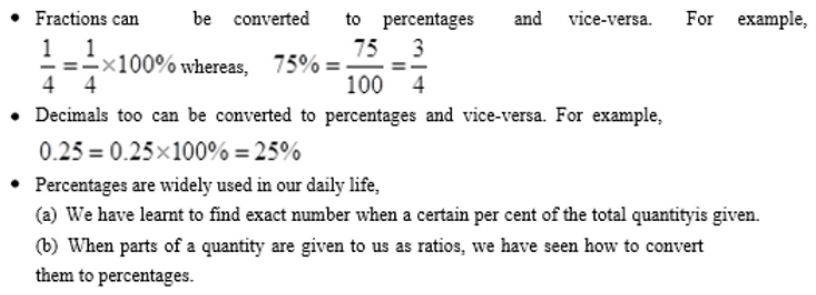
A way of comparing quantities is percentage. Percentages are numerators of fractions with denominator 100. Per cent means per hundred. For example 82% marks means
82 marks out of hundred.
Percentages are widely used in our daily life,
(a) We have learnt to find exact number when a certain per cent of the total quantity is given.
(b) When parts of a quantityare given to us as ratios, we have seen how to convert
them to percentages.
(c) The increase or decrease in a certainquantity can also be expressed as percentage.
(d) The profit or loss incurredin a certain transaction can be expressedin terms of percentages.
(e) While computing intereston an amount borrowed, the rate of interest is given in terms of per cents. For example, ` 800 borrowed for 3 years at 12% per annum. Simple Interest:Principal means the borrowed money.
The extra money paid by borrower for using borrowedmoney for given time is called interest(I).
The period for which the money is borrowed is called ‘TimePeriod’ (T).
Rate of interestis generally given in percentper year.
Interest, I = PTR/100
Total money paid by the borrower to the lenderis called the amount.
Hindi Version
Dig Deep
Topic Level Resources
Sub – Topics
Select A Topic
Topic:
Chapters Index
Select Another Chapter
[display-posts category=”CBSE 7 – Mathematics – Study – Premium” posts_per_page=”25″]
Exponents are used to express large numbers in shorter form to make them easy to read, understand, compare and operate upon. (Scroll down to continue …)
Study Tools
Audio, Visual & Digital Content
Expressing Large Numbers in the Standard Form: Any number can be expressed as a decimal number between 1.0 and 10.0 (including 1.0) multiplied by a power of 10. Such form of a number is called its standard form or scientific motion. Very large numbers are difficult to read, understand, compare and operate upon. To make all these easier, we use exponents, converting many of the large numbers in a shorter form. The following are exponential forms of some numbers?
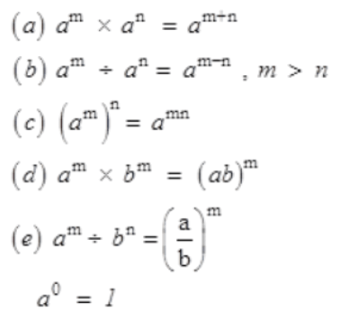
Here, 10, 3 and 2 are the bases, whereas 4, 5 and 7 are their respective exponents. We also say, 10,000 is the 4th power of 10, 243 is the 5th power of 3, etc. Numbers in exponential form obey certain laws, which are: For any non-zero integers a and b and whole numbers m and n,
(g) (–1) even number = 1 (–1) odd number = – 1
Hindi Version
Dig Deep
Topic Level Resources
Sub – Topics
Select A Topic
Topic:
Chapters Index
Select Another Chapter
[display-posts category=”CBSE 7 – Mathematics – Study – Premium” posts_per_page=”25″]
Congruence: The relation of two objects being congruent is called congruence. (Scroll down to continue …)
Study Tools
Audio, Visual & Digital Content
Chapter – 7
Congruence of Triangles
SSS Congruence of two triangles: Under a given correspondence, two triangles are congruent if the three sides of the one are equal to the three corresponding sides of the other.
SAS Congruenceof two triangles: Under a given correspondence, two triangles are
congruent if two sides and the angleincluded between them in one of the triangles are equal to the corresponding sides and the angle included between them of the other triangle.
ASA Congruence of two triangles: Under a given correspondence, two triangles are congruent if two anglesand the side included betweenthem in one of the triangles are equal to the corresponding angles and the side included between them of the other triangle.
RHS Congruence of two right-angled triangles: Under a given correspondence, two right-angled triangles are congruent if the hypotenuse and a leg of one of the triangles are equal to the hypotenuse and the corresponding leg of the other triangle.
There is no such thing as AAA Congruence of two triangles: Two triangles with equal corresponding angles need not be congruent. In such a correspondence, one of them can be an enlarged copy of the other.
(They would be congruent only if they are exact copies of one another).
Hindi Version
Dig Deep
Topic Level Resources
Sub – Topics
Select A Topic
Topic:
Chapters Index
Select Another Chapter
[display-posts category=”CBSE 7 – Mathematics – Study – Premium” posts_per_page=”25″]
The circle, thesquare, the rectangle, the quadrilateral and the triangle are examples of plane figures; the cube, the cuboid, the sphere, the cylinder, the cone and the pyramid areexamples of solid shapes.(Scroll down to continue …)
Study Tools
Audio, Visual & Digital Content
Plane figures areof two-dimensions (2-D) and the solid shapes are of three- dimensions (3-D). The corners of a solid shape are called its vertices; theline segments ofits skeleton areits edges; and itsflat surfaces areits faces. A net is a skeleton-outline of a solid that can be folded to make it. The same solid can haveseveral types ofnets. Solid shapes can be drawn on a flat surface (like paper) realistically. We call this 2-D representation of a 3-Dsolid. Two types ofsketches of asolid are possible: (a) An oblique sketch does nothave proportional lengths. Still it conveys all important aspects of the appearance of the solid. (b) An isometric sketch is drawn on an isometric dot paper, a sample of which isgiven at theend of thisbook. In an isometric sketch of the solidthe measurements kept proportional. Visualising solidshapesis a veryuseful skill. Youshould be ableto see ‘hidden’ parts of thesolid shape. Different sections of a solid can be viewed in many ways: (a) One way is to viewby cutting or slicing the shape, whichwould result in the cross- section of thesolid. (b) Another way isby observing a 2-D shadow of a 3-Dshape. (c) A third wayis to lookat the shapefrom different angles; the front-view, theside- view and thetop view canprovide a lotof information aboutthe shape observed.
19. When a grouping symbol preceded by ‘ sign is removed or inserted, thenthe sign of eachterm of thecorresponding expression ischanged (from ‘ + ‘ to ‘−’ and from‘− ‘ to + ‘).
Hindi Version
Dig Deep
Topic Level Resources
Sub – Topics
Select A Topic
Topic:
Chapters Index
Select Another Chapter
[display-posts category=”CBSE 7 – Mathematics – Study – Premium” posts_per_page=”25″]