Assessment Tools
Assign | Assess | Analyse
Quick Quiz
Objective Assessment
Question Bank
List Of Questions With Key, Aswers & Solutions
Back To Learn
Re – Learn
Go Back To Learn Again
Class Level Content Of A Subject
Assign | Assess | Analyse
Objective Assessment
List Of Questions With Key, Aswers & Solutions
Back To Learn
Go Back To Learn Again
Mind Map Overal Idea Content Speed Notes Quick Coverage Atoms are the basic building blocks of matter. Different kinds of matter contain different kinds of atoms present in them. Protons were discovered by Ernest Rutherford, in his famous gold foil experiment. Electrons were discovered by J.J. Thomson, in his cathode ray tube experiment. Neutrons were readmore
Overal Idea
Content
Quick Coverage
Atoms are the basic building blocks of matter.
Different kinds of matter contain different kinds of atoms present in them.
Protons were discovered by Ernest Rutherford, in his famous gold foil experiment.
Electrons were discovered by J.J. Thomson, in his cathode ray tube experiment.
Neutrons were discovered by James Chadwick. (Scroll down till end of the page)
Audio, Visual & Digital Content
Laws of Chemical Combination: Antoine Laurent Lavoisier, is known as ‘Father of Modern Chemistry.
Lavoisier put forward the law of conservation of mass, which laid the foundation of chemical sciences.
Law of Conservation of Mass: Law of Conservation of Mass states that, “mass is neither created nor destroyed in a chemical reaction.
In other words, the mass of the reactants must be equal to the mass of products.
Law of Constant Proportions or Definite Composition: Law of Constant Proportions or Definite Composition states that, in a pure chemical substance, the elements are always present in definite proportions by mass.
Dalton’s Atomic Theory:
(i) Every element is composed of extremely small particles called atoms.
(ii) Atoms of a given element are identical, both in mass and properties.
(iiii) Different chemical elements have different kinds of atoms; in particular, their atoms have different masses.
(iv) The atoms neither be created nor be destroyed or transformed into atoms of other elements.
(v) Compounds are formed when atoms of different elements combine with each other in small whole number ratios.
(vi) The relative number and kinds of atoms in a given compound are constant.
Drawbacks of Dalton’s Atomic Theory:
(i) According to modern theory, an atom is not the ultimate indivisible particle of matter. Today, we know that atoms are divisible, they are themselves made-up of particles (protons, electrons, neutrons,etc.).
(i) In the case of isotopes of an element, the assumption that the atoms of the same element have the same mass does not hold good.
Atom: It is the smallest particle of an element that maintains its chemical identity throughout all chemical and physical changes.
The smallest unit of a substance which can exist independently is called a molecule.
Atomicity: It is defined as the number of atoms present in a molecule of an element or a compound.
Mono atomic: Molecule having only one atom is called mono atomic,
e.g., He, Ne, Ar.
Diatomic: Molecules made-up of two atoms are called diatomic, e.g., H₂, Cl₂, O₂, N2.
Triatomic: Molecules made-up of three atoms, called triatomic.
e.g., O3, H₂O, NO2.
Tetraatomic : Molecules made-up of four atoms, called tetra atomic.
e.g., P4, NH3, SO3
Polyatomic: Molecules made-up of five or more atoms, called polyatomic/
e.g., CH4.
Polyatomic: Any molecule which is made-up of more than four atoms is called polyatomic,
e.g., Sg.
Relative Atomic Mass: It is defined as the number of times one atom of an element is heavier than
(1/12)th of the mass of an atom of Carbon – 12.
Relative Atomic Mass (RAM) = Mass of an atom of an element/
¹/12 th mass of C-12
Molecular Mass: The molecular mass of a substance is the sum of the atomic masses of all atoms in a molecule of a substance,
e.g., molecular mass of water is 18 u.
The mole (or mol) is the SI unit of the amount of a substance. One mole is equal to the amount of substance that contains as many elementary units as there are atoms in 12 g of the carbon-12 isotope.
The elementary units may be atoms, molecules, ions, radicals, electrons, etc., and must be specified.
This number is called Avogadro’s number (No) or Avogadro’s constant
[NA = 6.0221367 x 10²³]. Generally,Avogadro’s Number is rounded to 6.022 x 10²³.
For better understanding we can compare avogadro number with a dozen as:
One dozen oranges contain 12 oranges, similarly, 1 mole of hydrogen atoms contain 6.022 x 10²³ H atoms.
H₂O = 2 x H + 1 × O
= 2 x 1+1 x 16 = 2+16
= 18 amu or u.
By : 1 mole of a compound has a mass equal to its relative molecular mass expressed in grams.
1 mole = 6.022 × 10²³ number
= Relative mass in grams.
A molecule is the smallest particle of an element or a compound capable of independent existence under ordinary conditions. It shows all the properties of the substance.
A chemical formula of a compound shows its constituent elements and the number of atoms of each combining element.
Clusters of atoms that act as an ion are called polyatomic ions. They carry a fixed charge on them.
The chemical formula of a molecular compound is determined by the valency of each element.
In ionic compounds, the charge on each ion is used to determine the chemical formula of the compound.
Scientists use the relative atomic mass scale to compare the masses of different atoms of elements. Atoms of carbon-12 isotopes are assigned a relative atomic mass of 12 and the relative masses of all other atoms are obtained by comparison with the mass of a carbon-12 atom.
The Avogadro constant 6.022 × 10²³ is defined as the number of atoms in exactly 12 g of carbon-12.
The mole is the amount of substance that contains the same number of particles (atoms/ions/ molecules/formula units, etc.) as there are atoms in exactly 12g of carbon-12. Mass of 1 mole of a substance is called its molar mass.
The relative atomic mass of the atom of an element is the average mass of the atom as compared to 1/12th mass of one carbon-12 atom.
Hint: We know that chemical formulas can also be written using a criss-cross method. In the criss-cross method, the numerical value of the ion charge of the two atoms is crossed over, which becomes the subscript of the other ion. Using this technique, we will write the chemical formula of the given compounds.
Complete step by step answer:
Let’s us discuss about the given compound as,
A.Magnesium chloride
We have to remember that the atomic number of Magnesium is 12 and has a valency of 2.
It means it has two electrons in the outermost shell for bonding.
The atomic number of chlorine is 17 and has 7 electrons in the outermost shell.
It means it just needs one more atom for bonding.
Hence, we will use atoms of chlorine to bond with one atom of magnesium.
We can apply the criss-cross method for this compound as,

Therefore, the chemical formula of magnesium chloride is MgCl2
B.Calcium oxide
We have to know that the atomic number of calcium is 20 and has a valency of 2, it means it has 2 two atoms in the outermost shell for bonding.
The atomic number of Oxygen is 8
8 and has a valency of 2, it has 6 atoms in the outermost shell, it needs 2 more to complete the octet.
Hence, we need one calcium atom to bond with one oxygen atom.
We can apply the criss-cross method for this compound as,

Therefore, the chemical formula of magnesium chloride is CaO
C. Copper nitrate
We have to know that the atomic number of copper is 29 and has two atoms in the outermost shell for bonding. While a nitrate molecule has only one valence electron.
We need 2 nitrate molecules to satisfy the valency of 1 copper atom.
We can apply the criss-cross method for this compound as,

Therefore, the chemical formula of magnesium chloride is
Cu(NO3)2
D.Aluminium chloride
We have to know that the atomic number of aluminium is 13 and has a valency of 3 atoms and chlorine atom has a valency of 1. Since it has 7 electrons in the outermost shell.
Thus, we need 3 chlorine atoms to satisfy the valency of 1 aluminium atom.
We can apply the criss-cross method for this compound as,

Therefore, the chemical formula of magnesium chloride is AlCl3.
E.Potassium nitrate
We have to remember that the atomic number of potassium is 19 and has a valency of 1 and nitrate also has a valency of 1, since it needs one more atom to complete its octet. Hence, we need only one molecule of nitrate for one atom of potassium.
We can apply the criss-cross method for this compound as,

Therefore, the chemical formula of magnesium chloride is KNO3.
Note: As we know that the criss-cross method is the most efficient way to write the correct chemical formula of the molecule. It is generally used for finding out the formula of a bonding of a metal with a non-metal to form ionic bonds. Signs of the two ions are dropped, the ion value is crossed which becomes the subscript of the crossed atoms.
Topic Terminology
Term
Table:
.
Test Your Learning

Assign | Assess | Analyse
Objective Assessment
List Of Questions With Key, Aswers & Solutions
Back To Learn
Go Back To Learn Again
Mind Map Overal Idea Content Speed Notes Quick Coverage Two or more elements combine to form compounds. There are two types of compounds- Organic Compound and Inorganic Compounds. Organic compounds are the one which are made up of carbon and hydrogen. (Scroll down till the end…) Study Tools Audio, Visual & Digital Content Revision Notes readmore
Overal Idea
Content
Quick Coverage
Two or more elements combine to form compounds. There are two types of compounds- Organic Compound and Inorganic Compounds. Organic compounds are the one which are made up of carbon and hydrogen. (Scroll down till the end…)
Audio, Visual & Digital Content
Two or more elements combine to form compounds. There are two types of compounds- Organic Compound and Inorganic Compounds. Organic compounds are the one which are made up of carbon and hydrogen.
The bond formed by sharing a pair of electrons between two atoms is known as Covalent Bond. Carbon forms a covalent bond. Carbon exists in two forms- as free state and as combined state. Free form of carbon is found in graphite, diamond and fullerene. In a combined state, carbon exists as Carbon-dioxide, Glucose, Sugar etc.
Different forms of an element that has same chemical properties but different physical properties are known as Allotropes. There are three allotropes of carbon- diamond, graphite and fullerene.
Diamond exits as three-dimensional network with strong carbon-carbon covalent bonds. Diamond is hard in nature with high melting point. It shines in presence of light and it is a bad conductor of electricity. The most common use of diamond is in making jewellery. It is also used in cutting and drilling tools.
Graphite is made from weak van der wall forces. Each carbon atom is bonded with other three carbon atoms in order to form hexagonal rings. It serves as good conductor of heat and electricity. It is used as dry lubricant for machine parts as well as it is used in lead pencils.
It is a hollow cage which exits in the form of sphere. Its structure is similar to fullerene. But along with hexagonal rings, sometimes pentagonal or heptagonal rings are also present.

Fig.1 Structure of fullerene
Catenation and tetravalency are the two important properties of carbon.
Catenation is a property of carbon by which carbon atoms can link one another via covalent bond and can form long chains, closed rings or branched chains etc.
Multiple Bonds:
Carbon atoms can be linked by single, double or triple bonds.
Carbon has a valency of 4 due to which it is known to have tetravalency. Due to this one carbon atom can bond with other 4 carbon atoms, with other atoms also such as Oxygen, Nitrogen etc.
Compounds which are made up of carbon and hydrogen are known as Hydrocarbons.
There are two types of hydrocarbons found – Saturated Hydrocarbons and Unsaturated Hydrocarbons.
Saturated Hydrocarbons
Saturated Hydrocarbons consist of single bonds between the carbon atoms.
For Example, Alkanes. Alkanes are saturated hydrocarbons.
General formula of saturated hydrocarbons
CnH2n+2.
Unsaturated Hydrocarbons are the one with double or triple bonds between the carbon atoms.
For Example, Alkenes and Alkynes. Alkenes are represented as CnH2n whereas alkynes are represented as CnH2n-2. Some saturated hydrocarbons and unsaturated hydrocarbons are represented as –

Fig.2. Saturated hydrocarbons

Fig. 3. Unsaturated hydrocarbons
Structure of hydrocarbons can be represented in the form of electron dot structure as well as open structures as shown below-

Fig.4. Electron dot structure and open structure of ethane
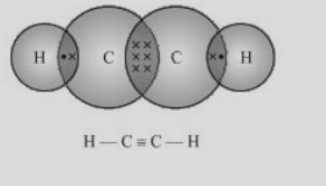
Fig.5. Electron dot structure and open structure of ethyne
Carbon Compounds can be classified as straight chain compounds, branched chain compounds and cyclic compounds.They are represented as –

Fig.6. Straight chain carbon compound
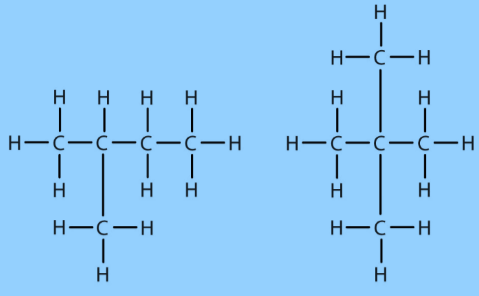
Fig.7. Branched chain compounds
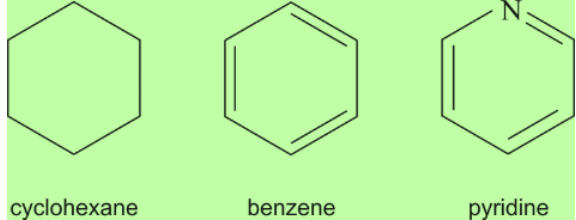
Fig.8. Cyclic carbon compounds
One of the hydrogen atoms in hydrocarbon can be replaced by other atoms according to their valencies. The atoms which decides the properties of the carbon atoms, are known as Functional Groups. For Example, Cl, Br, -OH, Aldehyde, Ketone, Carboxylic Acid etc.
Series of compounds in which same functional group substitutes for the hydrogen atom in a chain of carbon.
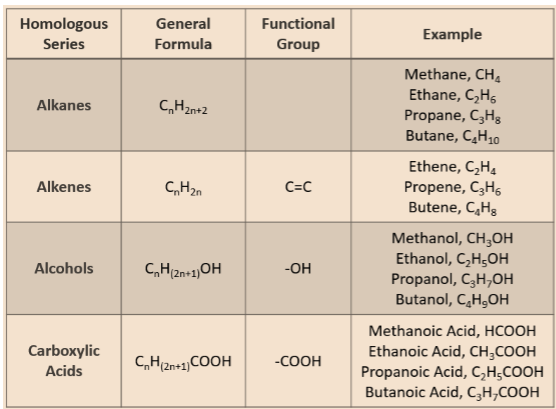
Fig.9. Homologous series
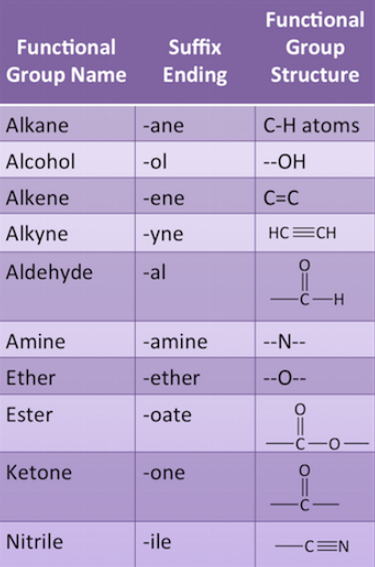
Fig.10. Different functional groups
Combustion
Carbon along with its compound is used as a fuel as it burns in presence of oxygen to release energy. Saturated hydrocarbons produce blue and non-sooty flame whereas unsaturated hydrocarbons produce yellow sooty flame.
CH4 + 2O2 → CO2 + 2H2O
Oxidation
Alcohol can be oxidized to aldehydes whereas aldehydes in turn can be oxidized to carboxylic acid. Oxidizing agent such as potassium permanganate can be used for oxidation.
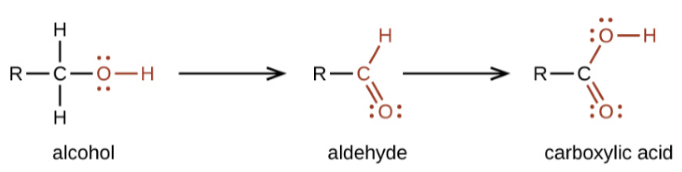
Hydrogenation of vegetable oil is an example of addition reaction. Addition of hydrogen in presence of catalyst such as nickel or palladium. This converts oil into ghee.

Substitution Reaction
When one atom in hydrocarbon is replaced by chlorine, bromine, etc. this is known as Substitution Reaction.

Ethanol is a volatile liquid with low melting point. It reacts with sodium to form sodium ethoxide.

This above reaction is used to test the presence of ethanol by the evolution of hydrogen gas.
Dehydration of ethanol in presence of hot sulphuric acid forms alkene.

Ethanoic acid is a colourless liquid. When pure ethanoic acid freeze like ice, it is known as Glacial Acetic Acid. It is formed at a temperature of about 16.6 degree centigrade
Ethanoic Acid/Acetic acid when reacts with ethanol it forms an ester. Ester can be identified by its sweet smell.
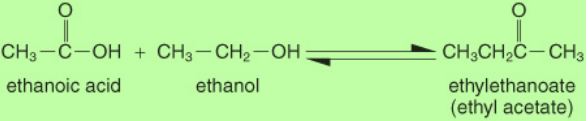
Reaction of ester with strong base is used to form soap. This is known as Saponification. Acetic acid also reacts with strong base to form sodium acetate and water.
NaOH + CH3COOH + CH3COONa + H2O
Sodium or potassium salt of carboxylic acid is known as Soap. They work most effectively in soap water. Detergents are sulphonate or ammonium salt of long chain of carboxylic acid. They can work effectively on soft as well as hard water.
Cleansing action of soaps and detergents is due to ability to minimize the surface tension of water, to emulsify oil or grease and to hold them in a suspension of water. When soap dissolves in water, it forms soap anions and soap cations. The hydrophobic part of soaps and detergents are soluble in grease and hydrophilic part is soluble in water.
When dirt and grease are mixed with soap water, soap molecules arrange them in tiny clusters known as Micelle. The hydrophilic part sticks to the water and form outer surface of the micelle and hydrophobic part binds to oil and grease.

Topic Terminology
Term:
Topic Terminology
Term:
Test Your Learning
Mind Map Overal Idea Content Speed Notes Quick Coverage Introduction to Circles There are many objects in our life which are round in shape. A few examples are the clock, dart board, cartwheel, ring, Vehicle wheel, Coins, etc. (Scroll down to continue …)(Scroll down till end of the page) Study Tools Audio, Visual & Digital readmore
Overal Idea
Content
Quick Coverage
Introduction to Circles
There are many objects in our life which are round in shape. A few examples are the clock, dart board, cartwheel, ring, Vehicle wheel, Coins, etc. (Scroll down to continue …)(Scroll down till end of the page)
Audio, Visual & Digital Content
Circles

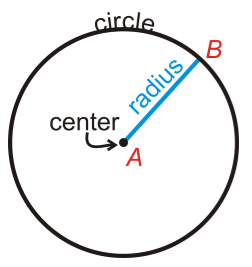
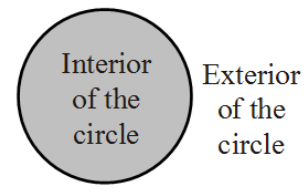
In a flat surface, the interior of a circle is the line whose distance from the centre is less than the radius.
The exterior of a circle is the line in the plane whose distance from the centre is larger than the radius.
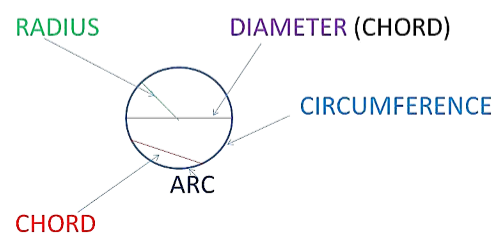
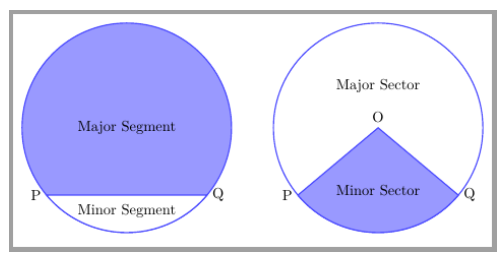
A segment of the circle is the region between either of its arcs and a chord. It could be a major or minor segment.
Sector of the circle is the area covered by an arc and two radii joining the centre of the circle. It could be the major or minor sector.
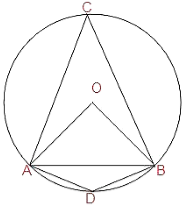
If in a circle AB is the chord and is making ∠ACB at any point of the circle then this is the angle subtended by the chord AB at a point C.
Likewise, ∠AOB is the angle subtended by chord AB at point O i.e. at the centre and ∠ADB is also the angle subtended by AB at point D on the circle.
Theorem 1: Any two equal chords of a circle subtend equal angles at the centre.
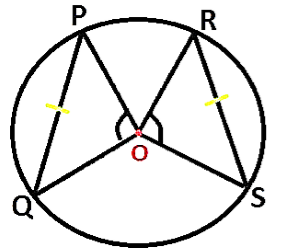
Here in the circle, the two chords are given and PQ = RS with centre O.
So OP = OS = OQ = OR (all are radii of the circle)
∆POQ ≅ ∆SOR
∠POQ = ∠SOR
This shows that the angles subtended by equal chords to the centre are also equal.
Theorem 2: If the angles made by the chords of a circle at the centre are equal, then the chords must be equal.
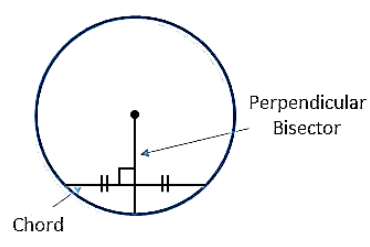
This theorem is the reverse of the above Theorem 1.
Perpendicular from the Centre to a Chord
Theorem 3: If we draw a perpendicular from the centre of a circle to any chord then it bisects the chord.
If we draw a perpendicular from the centre to the chord of the circle then it will bisect the chord. And the bisector will make a 90° angle to the chord.
Theorem 4: The line which is drawn from the centre of a circle to bisect a chord must be perpendicular to the chord.
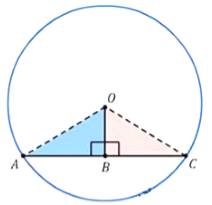
If we draw a line OB from the centre of the circle O to the midpoint of the chord AC i.e. B, then OB is the perpendicular to the chord AB.
If we join OA and OC, then
In ∆OBA and ∆OBC,
AB = BC (B is the midpoint of AC)
OA = OC (Both are the radii of the same circle)
OB = OB (same side)
Hence, ΔOBA ≅ ΔOBC (both are congruent by SSS congruence rule)
⇒ ∠OBA = ∠OBC (respective angles of congruent triangles)
∠OBA + ∠OBC = ∠ABC = 180° [Linear pair]
∠OBC + ∠OBC = 180° [Since ∠OBA = ∠OBC]
2 x ∠OBC = 180°
∠OBC = 90o
∠OBC = ∠OBA = 90°
∴ OB ⊥ AC
Theorem 5: There is one and only one circle passing through three given non-collinear points.
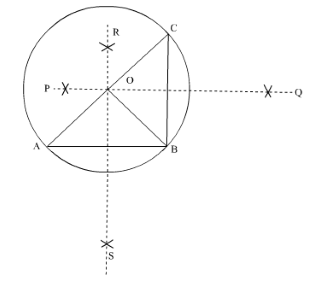
In this figure, we have three non-collinear points A, B and C. Let us join AB and BC and then make the perpendicular bisector of both so that RS and PQ the perpendicular bisector of AB and BC respectively meet each other at Point O.
Now take the O as centre and OA as the radius to draw the circle which passes through the three points A, B and C.
This circle is known as Circumcircle. Its centre and radius are known as the Circumcenter and Circumradius.
Theorem 6: Two equal chords of a circle are at equal distance from the centre.
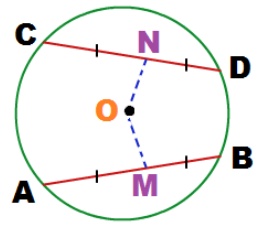
AB and CD are the two equal chords in the circle. If we draw the perpendicular bisector of these chords then the line segment from the centre to the chord is the distance of the chord from the centre.
If the chords are of equal size then their distance from the centre will also be equal.
Theorem 7: Chords at equal distance from the centre of a circle are also equal in length. This is the reverse of the above theorem which says that if the distance between the centre and the chords are equal then they must be of equal length.

The angle made by two different equal arcs to the centre of the circle will also be equal.
There are two arcs in the circle AB and CD which are equal in length.
So ∠AOB = ∠COD.
Theorem 8: The angle subtended by an arc at the centre is twice the angle subtended by the same arc at some other point on the remaining part of the circle.

In the above figure ∠POQ = 2∠PRQ.
Theorem 9: Angles from a common chord which are on the same segment of a circle are always equal.

If there are two angles subtended from a chord to any point on the circle which are on the same segment of the circle then they will be equal.
∠a = (1/2) ∠c (By theorem 8)
∠b = (1/2) ∠c
∠a = ∠b
Cyclic Quadrilaterals
If all the vertices of the quadrilateral come in a circle then it is said to be a cyclic quadrilateral.
Theorem 10: Any pair of opposite angles of a cyclic quadrilateral has the sum of 180º.

∠A + ∠B + ∠C + ∠D = 360º (angle sum property of a quadrilateral)
∠A + ∠C = 180°
∠B + ∠D = 180º
Theorem 11: If the pair of opposite angles of a quadrilateral has a sum of 180º, then the quadrilateral will be cyclic.
This is the reverse of the above theorem.
Topic Terminology
Term
Table:
.
Test Your Learning
Mind Map Overal Idea Content Speed Notes Quick Coverage Combustion: The process of burning a substance in the presence of air (oxygen) andundergoes a chemical reaction to produce heat and light. The substances which burn in air are called combustible. Oxygen (in air) is essential for combustion. During the process of combustion, heat and light readmore
Overal Idea
Content
Quick Coverage
Combustion: The process of burning a substance in the presence of air (oxygen) andundergoes a chemical reaction to produce heat and light. The substances which burn in air are called combustible.
Oxygen (in air) is essential for combustion. During the process of combustion, heat and light are given out. Ignition temperature is the lowest temperature at which a combustible substancecatches fire.
Types of combustion: The type of combustion differs depending on the type of fuel. (Scroll down till end of the page)
Audio, Visual & Digital Content
Based on nature and intensity combustions are classified into three types. They are:
(i) Rapid combustion
(ii) Spontaneous combustion
(iii) Explosion
Flame: It is a zone or burning vapour. The substances which vaporise during
burning give flames.
Example: Kerosene oil and molten wax. Inflammable substances have very low ignition temperature. Fire can be controlled by removing one or more requirements essential for producing fire. Water is commonly used to control fires. Water cannot be used to control fires involving electrical equipments or oils.
There are three different zones of a flame – dark zone, luminous zone and non-luminous zone.
Fuel is any material that is burned to obtain energy that can be used to heat or
A good fuel must:
Oxides of sulphur and nitrogen produced by the burning of coal, diesel and
petrol cause Acid rain which is harmful for crops, buildings and soil.
Be readily
available. Be cheap. Burn easily at a moderate rate.
Produce a large amount of heat. • Not leave behind any undesirable
Fuels differ in their efficiency and cost. Fuel efficiency is expressed in terms of its calorific value which is expressed in
units of kilo joule per kg.
Types of Fuels:
(i) Solid Fuels: Combustible substances which are solid at room
temperature.Example: coal, coke, wood, charcoal, etc. (ii) Liquid fuels: Volatile liquids which produce combustible vapour. Example:
Petrol,kerosene, alcohol, diesel, etc. (iii) Gaseous fuels: Combustible gases or mixture of combustible gases. Example:
Effects of Burning of Fuels:
(i) Carbon fuels like wood, coal petroleum release un burnt carbon particles. Theseare dangerous pollutants causing respiratory diseases, such as asthma.
(ii) Incomplete combustion of carbon fuels gives carbon monoxide which
is apoisonous gas.
(iii) Increased concentration of carbon dioxide in the air is believed to cause
globalwarming.
(iv) Oxides of Sulphur and nitrogen dissolve in rain water and form acids. Such
rain is Un burnt carbon particles in air are dangerous pollutants causing respiratoryproblems.
Incomplete combustion of a fuel gives poisonous carbon monoxide gas. Increased percentage of carbon dioxide in air has been linked to global warming.
Topic Terminology
Term
Table:
.
Test Your Learning
Assign | Assess | Analyse
Objective Assessment
List Of Questions With Key, Aswers & Solutions
Back To Learn
Go Back To Learn Again
Assign | Assess | Analyse
Objective Assessment
List Of Questions With Key, Aswers & Solutions
Back To Learn
Go Back To Learn Again
Assign | Assess | Analyse
Objective Assessment
List Of Questions With Key, Aswers & Solutions
Back To Learn
Go Back To Learn Again