Mind Map Overal Idea Content Speed Notes Quick Coverage Content : (Scroll down till end of the page) Study Tools Audio, Visual & Digital Content Content … Key Terms Topic Terminology Term Important Tables Table: . Assessments Test Your Learning readmore
Mind Map Overal Idea Content Speed Notes Quick Coverage We have discussed multiples, divisors, factors and have seenhow to identify factors and multiples. We have discussed and discovered thefollowing: (a) A factor of a number is an exactdivisor of thatnumber. (Scroll down till end of the page) Study Tools Audio, Visual & Digital Content (b) readmore
Mind Map
Overal Idea
Content
Speed Notes
Quick Coverage
We have discussed multiples, divisors, factors and have seenhow to identify factors and multiples. We have discussed and discovered thefollowing: (a) A factor of a number is an exactdivisor of thatnumber. (Scroll down till end of the page)
Study Tools
Audio, Visual & Digital Content
(b) Every number is a factor of itself. 1 is a factor ofevery number.
(c) Every factor ofa number isless than or equal tothe given number.
(d) Every number isa multiple ofeach of itsfactors.
(e) Every multiple ofa given number is greater thanor equal tothat number.
(f) Every number is a multiple of itself.
We have learnt that – (a) The number otherthan 1, withonly factors namely 1 and thenumber itself, isa prime number. Numbers that have more than two factors are called composite numbers. Number 1is neither prime nor composite.
(b) The number 2is the smallest prime number andis even. Every prime number other than 2 isodd.
(c) Two numbers withonly 1 asa common factor are called co-prime numbers.
(d) If a number is divisible byanother number thenit is divisible by each of the factors of that number.
(e) A number divisible by two co-prime numbers is divisible by their product also.
We have discussed how we can find just by looking at a number, whether it is divisible by small numbers 2,3,4,5,8,9 and 11.
We have explored the relationship between digits of thenumbers and theirdivisibility by different numbers.
(a) Divisibility by 2,5and 10 canbe seen byjust the lastdigit.
(b) Divisibility by 3and 9 ischecked by finding the sum ofall digits.
(c) Divisibility by 4 and 8is checked bythe last 2and 3 digits respectively.
(d) Divisibility of11 is checked by comparing thesum of digits at odd andeven places.
We have discovered that if twonumbers are divisible by a number then their sum and difference are also divisible by that number.
We have learnt that – (a) The Highest Common Factor (HCF) of two ormore given numbers is the highest of their common factors.
(b) The Lowest Common Multiple (LCM) of two ormore given numbers is the lowest of their common multiples.
Mind Map Overal Idea Content Speed Notes Quick Coverage Quadrilateral Any closed polygon with four sides, four angles and four vertices are called Quadrilateral. It could be regular or irregular. (Sroll down to continute till the end …) Study Tools Audio, Visual & Digital Content Quadrilateral Quadrilateral is a closed figure with four sides. Characteristics readmore
Mind Map
Overal Idea
Content
Speed Notes
Quick Coverage
Quadrilateral
Any closed polygon with four sides, four angles and four vertices are called Quadrilateral. It could be regular or irregular. (Sroll down to continute till the end …)
Study Tools
Audio, Visual & Digital Content
Quadrilateral
Quadrilateral is a closed figure with four sides.
Characteristics of a quadrilateral
Angle Sum Property of a Quadrilateral:
Qudrilateral is a four sided closed figure.
Sum of all angles of a quadrilateral is 360°.
Types Of Quadrilaterals
Classification of quadrilaterals
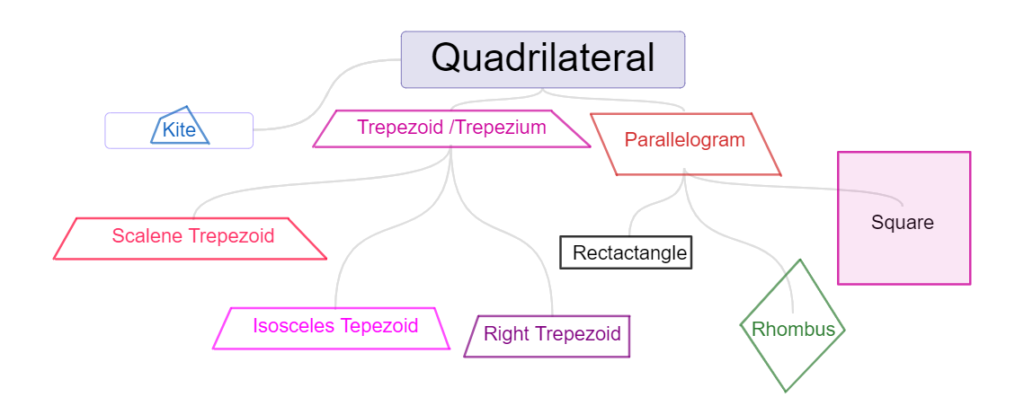
Quadrilaterals are broadly classified into three categories as:
(i) Kite
(ii) Trapezium
(ii) Parallelogram
Kite:
(i) Kite has no parallel sides
(ii) Kite has a pair of equal adjacent sides.
(ii) It is not a parallelogram
Characteristics Of Kite:
Perimeter Of Square
Area Of Kite
Trapezium:
Trapezium is a quadrilateral with the following characteristics:
(i) One pair of opposite sides is parallel to each other.
(ii) The other pair of opposite sides may not be parallel to each other.
Characteristics Of Trapezium
(i) Sum of all angles of a quadrilateral is 360°.
(ii) One pair of opposite sides is parallel to each other.
(iii) The other pair of opposite sides need not be parallel to each other.
Types Of Trapezium:
Quadrilaterals are broadly classified into two categories as:
(i) Isosceles Trapezium.
(ii) Scalene Trapezium.
(i) Right Trapezium.
Isosceles Trapezium:
Isosceles Trapezium is a quadrilateral with the following characteristics:
(i) One pair of opposite sides is parallel to each other.
(ii) The other pair of opposite sides are equal.
(iii) The other pair of opposite sides need not be parallel to each other.
Isosceles Trapezium is a trapezium with the following characteristics:
(i) One pair of opposite sides is parallel to each other.
(ii) The other pair of opposite sides are equal.
(iii) The other pair of opposite sides need not be parallel to each other.
Characteristics Of Isosceles Trapezium
(i) Sum of all angles of a quadrilateral is 360°.
(ii) One pair of opposite sides is parallel to each other.
(iii) The other pair of opposite sides are equal.
(iv) The other pair of opposite sides need not be parallel to each other.
Scalene Trapezium:
Scalene trapezium: Classified by the length of the legs or the measurement of their angles.
Characteristics Of Scalene Trapezium
Right Trapezium:
Right trapezium: Has one pair of parallel sides and one pair of right angles.
Characteristics Of Right Trapezium
Perimeter Of Trapezium
Area Of Trapezium
Parallelogram:
Parallelogram is a quadrilateral with the following characteristics:
(i) Two pairs of opposite sides are parallel to each other.
(ii) Two pairs of opposite sides are equal in length.
Characteristics of a parallelogram
(i) Sum of all angles of a Parallelogram is 360°.
(ii) Two pairs of opposite sides are parallel to each other.
(ii) Two pairs of opposite sides are equal in length.
(ii) Two pairs of opposite angles are equal.
(iii) Diagonals bisect each other.
(iv) Diagonals need not be equal to each other.
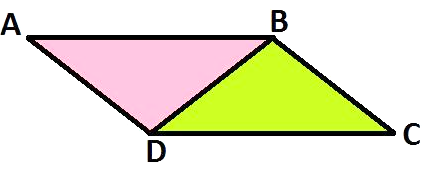
(v) Diagonals divide it into two congruent triangles.
Types Of Parallelogram
Parallelograms are broadly classified into three categories as:
(i) Rectangle
(ii) Rhombus
(iii) Square
Perimeter Of Parallelogram
Area Of Parallelogram
Rectangle:
Rectangleis a quadrilateral with the following characteristics:
(i) Two pairs of opposite sides are parallel to each other.
(ii) Two pairs of opposite sides are equal in length.
(iii) All four angles are right angles. (each angle is 90 o).
Characteristics Of Rectangle
(i) Sum of all angles of a quadrilateral is 360°.
(ii) Two pairs of opposite sides are parallel to each other.
(ii) Two pairs of opposite sides are equal in length.
(iii) All four angles are right angles. (each angle is 90 o).
(iii) Diagonals bisect each other.
(iv) Diagonals are equal to each other.
(v) Diagonals of a rectangle divide it into two congruent triangles.
Conclusions:
Every Rectangle is a Parallelogram. But Every Parallelogram need not to be a Rectangle.
Condition for a rhombus to be a square:
If all four angles of a parallelogram are right angles. (each angle is 90 o), the parallelogram becomes a Rectangle.
Perimeter Of Rectangle
Area Of Recatangle
Rhombus:
Rhombus is a quadrilateral with the following characteristics:
(i) Two pairs of opposite sides are parallel to each other.
(ii) All four sides are equal in length.
Characteristics Of Rhombus
(i) Sum of all angles of a quadrilateral is 360°.
(ii) Two pairs of opposite sides are parallel to each other.
(ii) All four sides are equal in length.
(ii) Two pairs of opposite angles are equal.
(iii) Diagonals bisect each other.
(iv) Diagonals need not be equal to each other.
(v) Diagonals divide a Rhombus into two congruent triangles.
Conclusions:
Every Rhombus is a Parallelogram. But Every Parallelogram need not to be a Rhombus.
Condition for a rhombus to be a square:
If all the sides of a parallelogram are equal, the parallelogram becomes a Rhombus.
Perimeter Of Rhombus
Area Of Rhombus
Square:
Square is a quadrilateral with the following characteristics:
(i) Two pairs of opposite sides are parallel to each other.
(ii) All four sides are equal in length.
(iii) All four angles are right angles. (each angle is 90 o).
Characteristics Of Square
(i) Sum of all angles of a quadrilateral is 360°.
(ii) Two pairs of opposite sides are parallel to each other.
(iii) All four sides are equal in length.
(iv) All four angles are right angles. (each angle is 90 o).
(v) Diagonals bisect each other.
(vi) Diagonals need not be equal to each other.
(vii) Diagonals divide a Rhombus into two congruent triangles.
Conclusions:
Every square is a Rhombus. But Every Rhombus need not to be a square.
Condition for a rhombus to be a square:
If all the angles of a rhombus are right angles (euqal to 90o), the rhombus becomes a square.
2. Every Square is a prallelogram. But Every prallelogram need not to be a square.
Condition for a prallelogramto be a square:
(i) If all the angles of a parallelogram are right angles (euqal to 90o), and all the sides of a parallelogram are equal in length, the parallelogram becomes a square.
3. Every Square is a rectangle. But Every Rectangle need not to be a square.
Condition for a Rectangleto be a square:
If all the sides of a Rectangle are equal in length, the Rectangle becomes a square.
If all the sides of a parallelogram are equal, the parallelogram becomes a Rhombus.
Perimeter Of Square
Area Of Square
Important Points To Remember
The diagonals of a parallelogram are equal if and only if it is a rectangle.
If a diagonal of a parallelogram bisects one of the angles of the parallelogram then it also bisects the opposite angle.
In a parallelogram, the bisectors of any two consecutive angles intersect at a right angle.
The angle bisectors of a parallelogram form a rectangle.
Mid Point Theorem
A line segment joining the mid points of any two sides of a triangle is parallel to the third side and length of the line segment is half of the parallel side.
Converse Of Mid Point Theorem
A line through the midpoint of a side of a triangle parallel to another side bisects the third side.
Intercept Theorem
If there are three parallel lines and the intercepts made by them on one transversal are equal then the intercepts on any other transversal are also equal.
Angle Sum Property of a Quadrilateral
The sum of the four angles of a quadrilateral is 360°
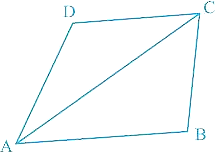
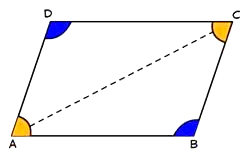
If we draw a diagonal in the quadrilateral, it divides it into two triangles.
And we know the angle sum property of a triangle i.e. the sum of all the three angles of a triangle is 180°.
The sum of angles of ∆ADC = 180°.
The sum of angles of ∆ABC = 180°.
By adding both we get ∠A + ∠B + ∠C + ∠D = 360°
Hence, the sum of the four angles of a quadrilateral is 360°.
Example
Find ∠A and ∠D, if BC∥ AD and ∠B = 52° and ∠C = 60° in the quadrilateral ABCD.
Solution:
Given BC ∥ AD, so ∠A and ∠B are consecutive interior angles.
So ∠A + ∠B = 180° (Sum of consecutive interior angles is 180°).
∠B = 52°
∠A = 180°- 52° = 128°
∠A + ∠B + ∠C + ∠D = 360° (Sum of the four angles of a quadrilateral is 360°).
∠C = 60°
128° + 52° + 60° + ∠D = 360°
∠D = 120°
∴ ∠A = 128° and ∠D = 120 °.
Types of Quadrilaterals
S No.
Quadrilateral
Property
Image
1.
Kite
a. No Parallel Sides b. Two pairs of adjacent sides are equal.
2.
Trapezium
One pair of opposite sides is parallel.
3.
Parallelogram
Both pairs of opposite sides are parallel.
3.
Rectangle
a. Both the pair of opposite sides are parallel. b. Opposite sides are equal.c. All the four angles are 90°.
4.
Square
a. All four sides are equal. b. Opposite sides are parallel. c. All the four angles are 90°.
5.
Rhombus
a. All four sides are equal. b. Opposite sides are parallel. c. Opposite angles are equal.d. Diagonals intersect each other at the centre and at 90°.
Remark: A square, Rectangle and Rhombus are also a parallelogram.
Properties of a Parallelogram
Theorem 1: When we divide a parallelogram into two parts diagonally then it divides it into two congruent triangles.
∆ABD ≅ ∆CDB
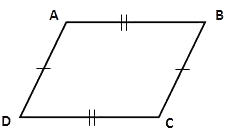
Theorem 2: In a parallelogram, opposite sides will always be equal.
Theorem 3: A quadrilateral will be a parallelogram if each pair of its opposite sides will be equal.
Here, AD = BC and AB = DC
Then ABCD is a parallelogram.
Theorem 4: In a parallelogram, opposite angles are equal.
In ABCD, ∠A = ∠C and ∠B = ∠D
Theorem 5: In a quadrilateral, if each pair of opposite angles is equal, then it is said to be a parallelogram. This is the reverse of Theorem 4.
Theorem 6: The diagonals of a parallelogram bisect each other.
Here, AC and BD are the diagonals of the parallelogram ABCD.
So the bisect each other at the centre.
DE = EB and AE = EC
Theorem 7: When the diagonals of the given quadrilateral bisect each other, then it is a parallelogram.
This is the reverse of the theorem 6.
The Mid-point Theorem
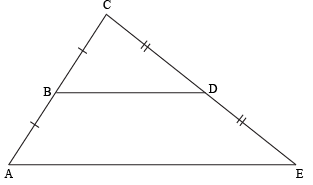
1. If a line segment joins the midpoints of the two sides of the triangle then it will be parallel to the third side of the triangle.
If AB = BC and CD = DE then BD ∥ AE.
2. If a line starts from the midpoint of one line and that line is parallel to the third line then it will intersect the midpoint of the third line.
If D is the midpoint of AB and DE∥ BC then E is the midpoint of AC.
Example
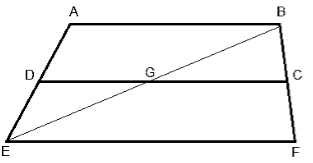
Prove that C is the midpoint of BF if ABFE is a trapezium and AB ∥ EF.D is the midpoint of AE and EF∥ DC.
Solution:
Let BE cut DC at a point G.
Now in ∆AEB, D is the midpoint of AE and DG ∥ AB.
By midpoint theorem, G is the midpoint of EB.
Again in ∆BEF, G is the midpoint of BE and GC∥ EF.
Mind Map Overal Idea Content Speed Notes Quick Coverage Reproduction is a process in which the organisms produce the young ones of their own kind. There are two modes by which animals reproduce. These are: (i) Sexual reproduction, and (ii) Asexual reproduction (Scroll down till end of the page) Study Tools Audio, Visual & Digital readmore
Mind Map
Overal Idea
Content
Speed Notes
Quick Coverage
Reproduction is a process in which the organisms produce the young ones of their own kind. There are two modes by which animals reproduce.
These are: (i) Sexual reproduction, and (ii) Asexual reproduction (Scroll down till end of the page)
Study Tools
Audio, Visual & Digital Content
Sexual Reproduction
Reproduction resulting from the fusion of male and female gametes is called sexual reproduction.
The reproductive organs in the female include ovaries, oviducts and uterus.
The reproductive organs in male include testes, sperm ducts and penis.
The ovary produces female gametes called ovum and the testes produce male gametes called sperms. The fusion of ovum and sperm is called fertilization.
zygote: The fertilized egg is called a zygote.
internal fertilization: Fertilization that takes place inside the female body is called internal fertilization. This is observed in human beings and other animals such as hens, cows and dogs.
external fertilization: Fertilization that takes place outside the female body is called external fertilization. This is observed in frogs, fish, starfish, etc.
The zygote divides repeatedly to give rise to an embryo. The embryo gets embedded in the wall of the uterus for further development.
The stage of the embryo in which all the body parts are identifiable is called foetus.
Animals such as human beings, cows and dogs which give birth to young Ones.
Asexual Reproduction: The type of reproduction in which only a single parent is involved is called asexual reproduction. The transformation of the larva into adult through drastic changes is called Asexual Reproduction
budding: In hydra, new individuals develop from buds. This method of asexual reproduction is called budding.
binary fission.: Amoeba reproduces by dividing itself into two. This type of asexual reproduction is called binary fission.
Mind Map Overal Idea Content Speed Notes Quick Coverage Respiration is essential for survival of living organisms. It releases energy from the food. The oxygen we inhale is used to breakdown glucose into carbon dioxide and water. Energy is released in this process. The breakdown of glucose occurs in the cells of an organism (cellular readmore
Mind Map
Overal Idea
Content
Speed Notes
Quick Coverage
Respiration is essential for survival of living organisms.
It releases energy from the food.
The oxygen we inhale is used to breakdown glucose into carbon dioxide and water.
Energy is released in this process.
The breakdown of glucose occurs in the cells of an organism (cellular respiration) (Scroll down till end of the page)
Study Tools
Audio, Visual & Digital Content
During heavy exercise when the supply of oxygen to our muscle cells is insufficient, food breakdown is by anaerobic respiration (without oxygen)
Types of Respiration:
External respiration also known as breathing refers to a process of inhaling oxygen from the air into the lungs and expelling carbon dioxide from the lungs to the air.
Exchange of gases both in and out of the blood occurs simultaneously.
Internal Respiration: Process in which food is broken down in body cells.
Internal respiration is further classified into two types as aerobic respiration and anaerobic respiration
(a) Aerobic Respiration: Aerobic respiration takes place in the presence of oxygen. Carbon dioxide and water are the end products of aerobic respiration. respiration happens in most of the organisms.
(b) Anaerobic Respiration: Anaerobic respiration takes place in the absence of oxygen.
Anaerobic respiration usually happens in most of the microbes.
Alcohol and carbon dioxide are formed at the end of anaerobic respiration.
In some cases, lactic acid is formed at the end of anaerobic respiration.
Respiration in Plants: Leaves have pores called stomata for gaseous exchange by diffusion.
Stems have openings called lenticels for gaseous exchange by diffusion.
Roots have stomatal pores for gaseous exchange of oxygen dissolved in soil water.
Respiration in Animals: Respiration in animals vary according to their character like:
Earthworm: Earthworms respire through their skin.
Insect: Insects respire through entire body surface.
Fish: Fishes respire through their gills.
Frogs: Frogs respire through their thin, moist and smooth skin when in water and by lungs when on the land.
Respiration in Humans: Inhaled air passes through nostrils into nasal cavity and then into lungs through windpipe.
Breathing is a part of the process of respiration during which an organism takes in the oxygen-rich air and gives out air rich in carbon dioxide.
The respiratory organs for the exchange of gases vary in different organisms.
During inhalation, our lungs expand and then come back to the original state as the air moves out during exhalation.
Increased physical activity enhances the rate of breathing.
In animals like cow, buffalo, dog and cat the respiratory organs and the process of breathing are similar to those in humans.