Assessment Tools
Assign | Assess | Analyse
Quick Quiz
Objective Assessment
Question Bank
List Of Questions With Key, Aswers & Solutions
Back To Learn
Re – Learn
Go Back To Learn Again
Class Level Content Of A Subject
Assign | Assess | Analyse
Objective Assessment
List Of Questions With Key, Aswers & Solutions
Back To Learn
Go Back To Learn Again
Mind Map Overal Idea Content Speed Notes Quick Coverage Force: A push or a pull, that changes or tends to change the state of rest or of uniform motion of an object or changes its direction or shape. A force arises due to the interaction between two objects. Force has magnitude as well as direction.Therefore readmore
Overal Idea
Content
Quick Coverage
Force: A push or a pull, that changes or tends to change the state of rest or of uniform motion of an object or changes its direction or shape.
A force arises due to the interaction between two objects.
Force has magnitude as well as direction.Therefore force is a vector quantity.
The SI unit of force is newton (Scroll down till end of the page)
Audio, Visual & Digital Content
A change in the speed of an object or the direction of its motion or both implies a change in its state of motion.
Force acting on an object may cause a change in its state of motion or a change in its shape.
Contact Non Contact Forces:
A force can act on an object with or without being in contact with it. Based on Contact the forces are classclassified as Contact Forces and Non Contact Forces.
Contact Forces: The forces act on a body when the source of force touches the body directly.
The point where the force is applied on an object is called the point of application of force (or point of contact).
Examples of Contact Forces:
(i) Muscular Force: The force exerted by the muscles of the body.
We use force acted by muscles of animals like Humans, bullocks, horses and camels to get our activities done.
(ii) Mechanical Force: The force acted by a machine.
Non-Contact Forces:
Non-Contact Forces: Forces which do not involve physical contact between two bodies on which they act.
Examples of Non-Contact Forces:
(i) Magnetic Force: A magnet exerts a non-contact force on objects made of iron, steel, cobalt or nickel.
(ii) Electrostatic Force: The force which result due to repulsion of similar charges or attraction of opposite charges.
(iii) Gravitational Forces: The force that exists between any two bodies by virtue of
Pressure
Pressure: Thrust acting per unit surface area is called pressure.
Thrust
Thrust is the force acting on an object perpendicular to its surface.
In SI system, pressure is measured in newton per square metre which is equal to 1 pascal (Pa).
Like solids, fluids (liquids and gases) also exert pressure.
A solid exerts pressure only in the downward direction due to its weight, whereas liquids and gases exert pressure inall directions.
Hence liquids and gases exert pressure on the walls of their container.
Atmospheric Pressure
Ttmosphere: The thick blanket of air that covers the earth is termed atmosphere.
The pressure exerted by the atmosphere is called atmospheric Pressure.
The tremendous atmospheric pressure surrounding us is not felt by us because the fluid pressure inside our bodies counter-balances the atmospheric pressure around us.
Topic Terminology
Term
Table:
.
Test Your Learning
Assign | Assess | Analyse
Objective Assessment
List Of Questions With Key, Aswers & Solutions
Back To Learn
Go Back To Learn Again
Mind Map Overal Idea Content Speed Notes Quick Coverage Content Study Tools Content … Key Terms Topic Terminology Term: Important Tables Topic Terminology Term: Assessments Test Your Learning readmore
Overal Idea
Content
Quick Coverage
Content
Content …
Topic Terminology
Term:
Topic Terminology
Term:
Test Your Learning
Assign | Assess | Analyse
Objective Assessment
List Of Questions With Key, Aswers & Solutions
Back To Learn
Go Back To Learn Again
Mind Map Overal Idea Content Speed Notes Quick Coverage Content : (Scroll down till end of the page) Study Tools Audio, Visual & Digital Content Speed Notes Quick Coverage Introduction To Trigonometry | Speed Notes Notes For Quick Recap An angle is positive if its rotation is in the anticlockwise and negative if its rotation readmore
Overal Idea
Content
Quick Coverage
Content : (Scroll down till end of the page)
Audio, Visual & Digital Content
Quick Coverage
Introduction To Trigonometry | Speed Notes
Notes For Quick Recap
An angle is positive if its rotation is in the anticlockwise and negative if its rotation is in the clockwise direction.

(Scroll down to continue …)
Audio, Visual & Digital Content


If one of the trigonometric ratios of an acute angle is known, the remaining trigonometric ration of the angle can be determined.
Two angles are said to be complementary, if their sum is 900 and each one of them is called the complement of the other.
sin (900 – θ) = Cos θ
Cos (900– θ)= Sin θ
tan (900– θ) = Cot θ
Cot(900– θ) = tan θ
sec (900– θ)= cosec θ
cosec (900– θ) = sec θ

An equation with trigonometric ratios of an angle θ, which is true for all values of ‘ θ ‘, for which the given trigonometric ratios are defined, is called an identity.
The three fundamental trigonometric identities are

⇒ sin2 θ =1-cos2 θ
⇒ sin2 θ =(1-cos θ)(1+cos θ)
⇒ (1- cos θ) = (sin2 θ) /(1+ cos θ)
⇒ (1+ cos θ) = (sin2 θ) /(1- cos θ)
⇒ cos2 θ + sin2 θ = 1
cos2 θ =1- sin2 θ
⇒ cos2 θ =(1- sin θ)(1+ sin θ)
⇒ (1+ sin θ) = (cos2 θ) /(1- sin θ)
⇒ (1- sin θ) = cos2 θ /(1+sin θ)
(b) sec2 θ = 1 + tan2 θ
⇒ sec2 θ – tan2 θ =1
⇒ (sec θ – tan θ)(sec θ + tan θ) = 1
⇒ (sec θ – tan θ) = 1/ (sec θ + tan θ)
⇒ (sec θ + tan θ) = 1/ (sec θ – tan θ)
⇒ sec2 θ – 1 = tan2 θ
⇒ (sec θ – 1)( sec θ – 1) = tan2 θ
(c) cosec2 θ = 1+cot2θ
⇒ cosec2 θ – cot2 θ = 1
⇒ (cosec θ – cot θ)(cosec θ + cot θ)=1
(cosec θ+ cot θ) =1cosec θ – cot θ
(cosec θ- cot θ) = 1cosec θ + cot θ
⇒ Cosec2 θ – 1 = cot2 θ
⇒ (Cosec θ – 1)( Cosec θ – 1) = Cot2 θ
(a+b)2=+a2+b2+2ab
(a-b)2 = a2+b2-2ab
(a+b)2+(a-b)2= 2 (a2+b2)
(a+b)2– (a-b)2= 4ab
(a-b)2– (a+b)2= – 4ab
(a+b)2 = (a-b)2+ 4ab
(a-b)2 = (a+b)2– 4ab
(a2-b2)=(a+b)(a-b)
a+b=(a2-b2) /(a-b)
a-b=(a2-b2) /(a-b)
(a+b)2= (a-b)2+ 4ab
Topic Terminology
Term
Table:
.
Test Your Learning
Mind Map Overal Idea Content Speed Notes Quick Coverage Basic terms and Definitions 1. Point – A Point is that which has no component. It is represented by a dot. 2. Line – When we join two distinct points then we get a line. A line has no endpoints; it can be extended on both readmore
Overal Idea
Content
Quick Coverage
Basic terms and Definitions
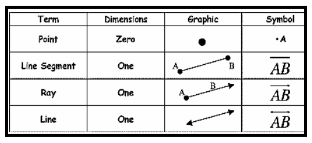
1. Point – A Point is that which has no component. It is represented by a dot.
2. Line – When we join two distinct points then we get a line. A line has no endpoints; it can be extended on both sides infinitely.
3. Line Segment Line – Segment is the part of the line which has two endpoints.
4. Ray – Ray is also a part of the line that has only one endpoint and has no end on the other side.
5. Collinear points: Points lying on the same line are called Collinear Points.
6. Non-collinear points: Points which do not lie on the same line are called Non-Collinear Points. (Scroll to continue …)
(Scroll down till end of the page)
Audio, Visual & Digital Content
When two rays begin from the same endpoint then they form an Angle. The two rays are the arms of the angle and the endpoint is the vertex of the angle.
| Angle | Notation | Image |
| Acute | An angle which is between 0° and 90°. | 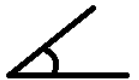 |
| Right | An angle which is exactly equal to 90°. |  |
| Obtuse | An angle which is between 90° and 180°. | 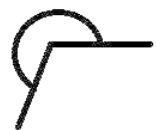 |
| Reflex | An angle which is between 180° and 360° | 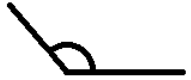 |
| Straight | An angle which is exactly equal to 180°. |  |
| Complete | An angle which is exactly equal to 360°. |  |
Complementary Angles are the different angles whose sum is 90°.
Complementary Angles are the different angles whose sum is 180°.

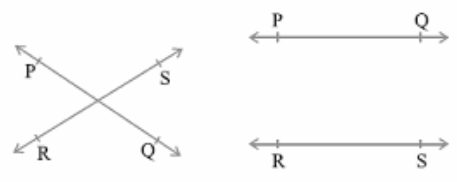
There are two ways to draw two lines-
1. The lines which cross each other from a particular point are called Intersecting Lines.
2. The lines which never cross each other at any point are called Non-intersecting Lines. These lines are called Parallel Lines and the common length between two lines is the distance between parallel lines.

1. If a ray stands on a line, then the sum of two adjacent angles formed by that ray is 180°.
This shows that the common arm of the two angles is the ray which is standing on a line and the two adjacent angles are the linear pair of the angles. As the sum of two angles is 180° so these are supplementary angles too.
2. If the sum of two adjacent angles is 180°, then the arms which are not common of the angles form a line.
This is the reverse of the first axiom which says that the opposite is also true.
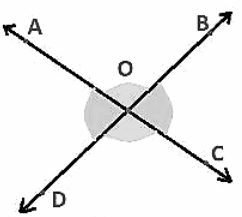
When two lines intersect each other, then the vertically opposite angles so formed will be equal.
AC and BD are intersecting each other so ∠AOD = ∠BOC and ∠AOB = DOC.

If a line passes through two distinct lines and intersects them at distant points then this line is called Transversal Line.
Here line “l” is transversal of line m and n.
Exterior Angles – ∠1, ∠2, ∠7 and ∠8
Interior Angles – ∠3, ∠4, ∠5 and ∠6
Pairs of angles formed when a transversal intersects two lines-
1. Corresponding Angles:
2. Alternate Interior Angles:
3. Alternate Exterior Angles:
4. Interior Angles on the same side of the transversal:

1. If a transversal intersects two parallel lines, then
2. If a transversal intersects two lines in such a way that
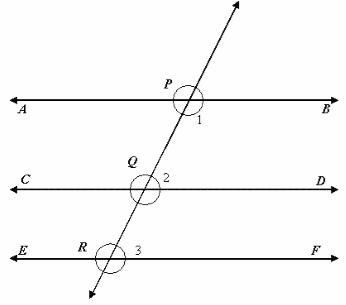
If two lines are parallel with a common line then these two lines will also be parallel to each other.
As in the above figure if AB ∥ CD and EF ∥ CD then AB ∥ EF.

1. The sum of the angles of a triangle is 180º.
∠A + ∠B + ∠C = 180°
2. If we produce any side of a triangle, then the exterior angle formed is equal to the sum of the two interior opposite angles.
∠BCD = ∠BAC + ∠ABC.
Topic Terminology
Term
Table:
.
Test Your Learning
Mind Map Overal Idea Content Speed Notes Quick Coverage Content : (Scroll down till end of the page) Study Tools Audio, Visual & Digital Content Content … Key Terms Topic Terminology Term Important Tables Table: . Assessments Test Your Learning readmore
Overal Idea
Content
Quick Coverage
Content : (Scroll down till end of the page)
Audio, Visual & Digital Content
Content …
Topic Terminology
Term
Table:
.
Test Your Learning
Mind Map Overal Idea Content Speed Notes Quick Coverage Content : (Scroll down till end of the page) Study Tools Audio, Visual & Digital Content Content … Key Terms Topic Terminology Term Important Tables Table: . Assessments Test Your Learning readmore
Overal Idea
Content
Quick Coverage
Content : (Scroll down till end of the page)
Audio, Visual & Digital Content
Content …
Topic Terminology
Term
Table:
.
Test Your Learning