Assessment Tools
Assign | Assess | Analyse
Quick Quiz
Objective Assessment
Question Bank
List Of Questions With Key, Aswers & Solutions
Back To Learn
Re – Learn
Go Back To Learn Again
Class Level Content Of A Subject
Assign | Assess | Analyse
Objective Assessment
List Of Questions With Key, Aswers & Solutions
Back To Learn
Go Back To Learn Again
Mind Map Overal Idea Content Speed Notes Quick Coverage Introduction : Circumference of a circle Or Perimeter of a circle : The distance around the circle or the length of a circle is called its circumference or perimeter. (Scroll down till end of the page) Study Tools Audio, Visual & Digital Content Introduction : Circumference readmore
Overal Idea
Content
Quick Coverage
Introduction :
Circumference of a circle Or Perimeter of a circle :

The distance around the circle or the length of a circle is called its circumference or perimeter. (Scroll down till end of the page)
Audio, Visual & Digital Content

Introduction :
Circumference of a circle Or Perimeter of a circle :
The distance around the circle or the length of a circle is called its circumference or perimeter.
Circumference (perimeter) of a circle = d or 2r, where d is a diameter and r is a radius of the circle and = 227 or 3.14

Area of a circle:

Area of a circle = πr2
Area of a semicircle :
Area of semicircle = 12 πr2
Area of a quadrant :
Area of a quadrant (quarter circle) = r24
Perimeter of a semicircle:
Perimeter of a semicircle or protractor =πr+2r

Area of the ring :
Area of the ring or an annulus
 = πR2 – πr2
= π(R2 – r2)
= π(R- r)(R+r)
Length of the arc AB
= 2πrθ3600 or πrθ1800

Area of a sector:
Area of sector OACBO =πrθ3600
OR
Area of sector OACBO = 12(r×l)

Perimeter of a sector :
Perimeter of sector OACBO
= Length of arc AB+2r
= πrθ1800+2r

Other important formulae :
(i) Distance moved by a wheel in 1 revolution = Circumference of the wheel.
(ii) Number of revolutions in one minute = Distance moved in 1 minuteCircumference
(iii) Angle described by minute hand in 60 minutes =3600
(iv) Angle described by hour hand in 12 hours = 3600
The midpoint of the hypotenuse of a right triangle is equidistant from the vertices of the triangle.
Angle subtended at the circumference by a diameter is always a right angle.
Area of a segment:
(i) Area of minor segment ACBA
= Area of sector OACBO- Area of ∆OAB
= πrθ3600- 12r2sinθ

(ii) Area of major segment BDAB
= Area of the circle – Area of minor segment ACBA
=πr2 – Area of minor segment ACBA
If a chord subtends a right angle at the center, then
Area of the corresponding segment = 4-12r2
If a chord subtends an angle of 600 at the center, then
Area of the corresponding segment = 6-32r2
If a chord subtends an angle of 1200 at the center, then Area of the corresponding segment = 3-34r2
Topic Terminology
Term
Table:
.
Test Your Learning

Assign | Assess | Analyse
Objective Assessment
List Of Questions With Key, Aswers & Solutions
Back To Learn
Go Back To Learn Again
Mind Map Overal Idea Content Speed Notes Quick Coverage Materials through which electric current can pass through easily are called electric conductors or conductors of electricity. Electrical conductivity Or Electric Conductivity: Electrical conductivity is a measure of the ability of a substance to allow the flow of electric current. Among solids metals and graphite are readmore
Overal Idea
Content
Quick Coverage
Materials through which electric current can pass through easily are called electric conductors or conductors of electricity.
Electrical conductivity Or Electric Conductivity: Electrical conductivity is a measure of the ability of a substance to allow the flow of electric current.
Among solids metals and graphite are good conductors which have high electrical conductivity.
Some liquids are also good conductors. (Scroll down till end of the page)
Audio, Visual & Digital Content
Pure water or distilled water is a poor conductor of electricity. But the presence of even small amount of impurities(salts and minerals) makes water a good conductor as it contains ions through which conduction takes place.
Hence water from taps, wells, lakes, etc. conduct electricity as they contain impurities.
Most liquids that conduct electricity are solutions of acids, bases and salts.
When electricity is passed through a conducting solution, the molecules of the solution dissociate into ions.
Ions are atoms or group of atoms with a positive or a negative charge.
These ions cause electrical conduction through the liquid.
Electrolyte: A liquid That conducts electricity is called an electrolyte.
Electrolysis:
The process of chemical decomposition compound in a solution when an electric current passes through it is called electrolysis.
Electrolysis, is due to the chemical effect of electric current.
electrolytic cell: Two electrodes are inserted in the solution and are connected to the terminals of a battery with a switch in between them.
This arrangement is called an electrolytic cell.
anode: The electrode that is connected to the positive terminal of the battery is called the anode,
cathode: The electrode that is connected to the negative terminal of the battery is called the cathode.
Electrolysis is used in refining, electroplating and extraction of metals from impure samples.
electrorefining: This process of refining and extraction of metals from impure samples is called electrorefining.
electroplating: electroplating is the process of coating a useful metal with another metal.
chemical effect of electric current: The process of passing an electric current through a conducting solution to cause chemical reactions is known as the chemical effect of electric current.
Chemical effects of electric current:
(i) Formation of bubbles of a gas on the electrodes.
(ii) Deposition of metal on electrodes.
(iii) Change in colour of solutions.
Electroplating: The process of depositing a layer of any desired metal on another material by means of electricity is called electroplating. The object to be electroplated is made the cathode (negative electrode) by connecting it to thenegative terminal of the battery.
The metal which has to be deposited is made the anode (positive electrode) by connecting it to the positive terminal of the battery. Usually a salt solution of the metal to be coated is made as anode.
Application of Electroplating:
(i) Metals that rust are often coated with other metals to prevent rusting.
(ii) Chromium plating is found on bath taps, car bumpers, etc. to give a bright attractive appearance and resist scratches and wear.
(iii) Silver plating is done on cutlery and jewellery items.
(iv) Tin cans, used for storing food, are made by electroplating tin onto iron.
Tin is less reactive than iron. Thus, food does not come into contact with iron and is protected from getting spoilt.
Topic Terminology
Term
Table:
.
Test Your Learning
Mind Map Overal Idea Content Speed Notes Quick Coverage Cartesian System A plane formed by two number lines, one horizontal and the other vertical, such that they intersect each other at their zeroes, and then they form a Cartesian Plane. (Scroll down till end of the page) Study Tools Audio, Visual & Digital Content ● readmore
Overal Idea
Content
Quick Coverage
Cartesian System

A plane formed by two number lines, one horizontal
and the other vertical, such that they intersect each
other at their zeroes, and then they form a Cartesian
Plane.
(Scroll down till end of the page)
Audio, Visual & Digital Content
● The horizontal line is known as the x-axis and the vertical line is known
as the y-axis.
● The point where these two lines intersect each other is called the origin.
It is represented as ‘O’.
● OX and OY are the positive directions as the positive numbers lie in the
right and upward direction.
● Similarly, the left and the downward directions are the negative directions
as all the negative numbers lie there.

Quadrants of the Cartesian Plane The Cartesian plane is divided into four quadrants namely Quadrant I, Quadrant II, Quadrant III, and Quadrant IV anticlockwise from OX.

Coordinates of a Point To write the coordinates of a point we need to follow the following rules. ● Thex – coordinate of a point is marked by drawing perpendicular from the y-axis measured a length of the x-axis .It is also called the Abscissa.

They – coordinate of a point is marked by drawing a perpendicular from the x-axis measured a length of the y-axis .It is also called the Ordinate. ● While writing the coordinates of a point in the coordinate plane, the x – coordinate comes first, and then the y – coordinate. We write the coordinates in brackets. In figure, OB = CA = x coordinate (Abscissa), and CO = AB = y coordinate (Ordinate). We write the coordinate as (x, y).
Remarks:

As the origin, O has zero distance from the x-axis and the y-axis so its abscissa and ordinate are zero. Hence the coordinate of the origin is (0, 0). The relationship between the signs of the coordinates of a point and the quadrant of a point in which it lies.

Plotting a Point in the Plane if its Coordinates are Given

Steps to plot the point (2, 3) on the Cartesian plane:
● First of all, we need to draw the Cartesian plane by drawing the coordinate axes with 1 unit = 1 cm.
● To mark the x coordinates, starting from 0 moves towards the positive x-axis and counts to 2.
● To mark the y coordinate, starting from 2 moves upwards in the positive direction and counts to 3.
● Now this point is the coordinate (2, 3). Likewise, we can plot all the other points, like (-3, 1) and (-1.5,-2.5) in the figure.
Question: Are the coordinates (x, y) = (y, x)? Let x = (-4) and y = (-2) So (x, y) = (- 4, – 2) (y, x) = (- 2, – 4)

Let’s mark these coordinates on the Cartesian plane. You can see that the positions of both the points are different in the Cartesian plane. So, If x ≠ y, then (x, y) ≠ (y, x), and (x, y) = (y, x), if x = y.
Example: Plot the points (6, 4), (- 6,- 4), (- 6, 4) and (6,- 4) on the Cartesian plane.

Solution: Since both numbers 6, 4 are positive the point (6, 4) lies in the first quadrant. For x coordinate, we will move towards the right and count to 6. Then from that point go upward and count to 4. Mark that point as the coordinate (6, 4). Similarly, we can plot all the other three points.

Topic Terminology
Term
Table:
.
Test Your Learning
Assign | Assess | Analyse
Objective Assessment
List Of Questions With Key, Aswers & Solutions
Back To Learn
Go Back To Learn Again
Mind Map Overal Idea Content Speed Notes Quick Coverage Variations: If the values of two quantities depend on each other in such a way that a change in one causes corresponding change in the other, then the two quantities are said to be in variation. (Scroll down till end of the page) Study Tools Audio, readmore
Overal Idea
Content
Quick Coverage
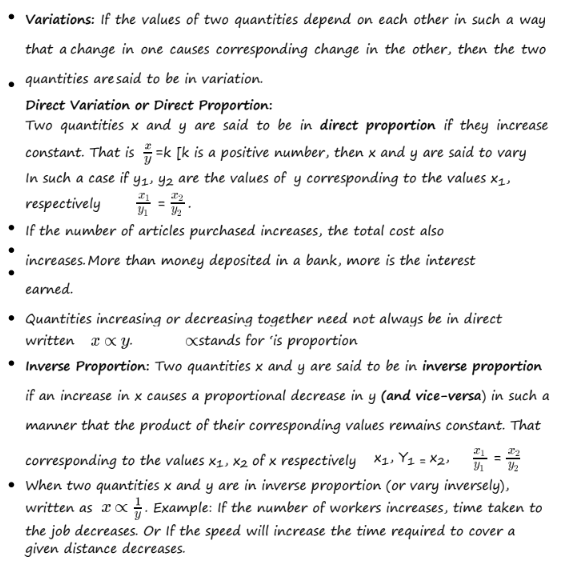
Variations: If the values of two quantities depend on each other in such a way that a change in one causes corresponding change in the other, then the two quantities are said to be in variation. (Scroll down till end of the page)
Audio, Visual & Digital Content
Direct Variation or Direct Proportion:
Extra:
Two quantities x and y are said to be in direct proportion if they increase (decrease) together in such a manner that the ratio of their corresponding values remains
constant. That is if
=k [k is a positive number, then x and y are said to vary directly.
In such a case if y1, y2 are the values of y corresponding to the values x1, x of x
respectively then = .
If the number of articles purchased increases, the total cost also increases. More than money deposited in a bank, more is the interest earned.
Quantities increasing or decreasing together need not always be in direct proportion, same in the case of inverse proportion.
When two quantities x and y are in direct proportion (or vary directly), they are
written as
. Symbol
stands for ‘is proportion to’.
Inverse Proportion: Two quantities x and y are said to be in inverse proportion if an increase in x causes a proportional decrease in y (and vice-versa) in such a manner that the product of their corresponding values remains constant. That is, if xy
= k, then x and y are said to vary inversely. In this case if y1, y2 are the values of y
corresponding to the values x1, x2 of x respectively then
x1, Y1 = x2, y2 or
=
When two quantities x and y are in inverse proportion (or vary inversely), they are
written as x
. Example: If the number of workers increases, time taken to finish
the job decreases. Or If the speed will increase the time required to cover a given distance decreases.
| Time (hours) | Distance (km) | Formula |
|---|---|---|
| 0 | 0 | |
| 1 | 60 | |
| 2 | 120 | |
| 3 | 180 |
| Number of Apples | Total Cost ($) | Formula |
|---|---|---|
| 0 | 0 | |
| 1 | 2 | |
| 2 | 4 | |
| 5 | 10 |
| Number of Servings | Amount of Flour (cups) | Formula |
|---|---|---|
| 0 | 0 | |
| 4 | 2 | |
| 6 | 3 | |
| 8 | 4 |
| Distance (km) | Fuel Consumed (liters) | Formula |
|---|---|---|
| 0 | 0 | |
| 15 | 1 | |
| 30 | 2 | |
| 45 | 3 |
| Hours Worked | Total Earnings ($) | Formula |
|---|---|---|
| 0 | 0 | |
| 1 | 15 | |
| 5 | 75 | |
| 10 | 150 |
Topic Terminology
Term
Table:
.
Test Your Learning
Assign | Assess | Analyse
Objective Assessment
List Of Questions With Key, Aswers & Solutions
Back To Learn
Go Back To Learn Again
Assign | Assess | Analyse
Objective Assessment
List Of Questions With Key, Aswers & Solutions
Back To Learn
Go Back To Learn Again