Level: Chapter

Chapter Level Content

  • Carbon and its Compounds | Study

  • CIRCLES | Study

  • COMBUSTION AND FLAME | Study

  • CONSERVATION OF PLANTS AND ANIMALS | Assess

  • Exploring Magnets | Assess

  • Life Processes | Assess

  • Lines and Angles | Assess

  • Lines and Angles | Assess

  • Lines and Angles | Study

  • Carbon and its Compounds | Study

    Mind Map Overal Idea Content Speed Notes Quick Coverage Two or more elements combine to form compounds. There are two types of compounds- Organic Compound and Inorganic Compounds. Organic compounds are the one which are made up of carbon and hydrogen. (Scroll down till the end…) Study Tools Audio, Visual & Digital Content Revision Notes readmore

    Mind Map

    Overal Idea

    Content

    Speed Notes

    Quick Coverage

    Two or more elements combine to form compounds. There are two types of compounds- Organic Compound and Inorganic Compounds. Organic compounds are the one which are made up of carbon and hydrogen. (Scroll down till the end…)

    Study Tools

    Audio, Visual & Digital Content

    Hindi Version

    Key Terms

    Topic Terminology

    Term:

    Important Tables

    Topic Terminology

    Term:

    Thumbnail - Study, Assess, Interact
    Advanced Tools For Study Assess Interact
    • CIRCLES | Study

      Mind Map Overal Idea Content Speed Notes Quick Coverage Introduction to Circles There are many objects in our life which are round in shape. A few examples are the clock, dart board, cartwheel, ring, Vehicle wheel, Coins, etc. (Scroll down to continue …)(Scroll down till end of the page) Study Tools Audio, Visual & Digital readmore

      Mind Map

      Overal Idea

      Content

      Speed Notes

      Quick Coverage

      Introduction to Circles

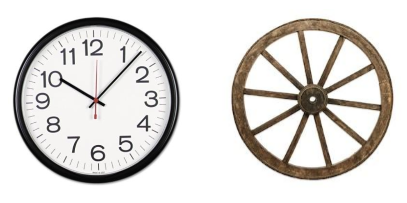
      There are many objects in our life which are round in shape. A few examples are the clock, dart board, cartwheel, ring, Vehicle wheel, Coins, etc. (Scroll down to continue …)(Scroll down till end of the page)

      Study Tools

      Audio, Visual & Digital Content

      Circles

      Circles

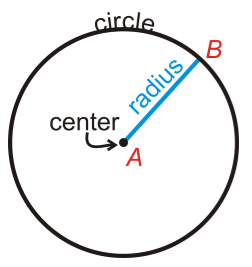
      • Any closed shape with all points connected at equidistant from the centre forms a Circle.
      • Any point which is equidistant from anywhere from its boundary is known as the Centre of the Circle.
      • Circles
      • Radius is a Latin word which means ‘ray’ but in the circle it is the line segment from the centre of the circle to its edge. So any line starting or ending at the centre of the circle and joining anywhere on the border of the circle is known as the Radius of Circle.

      Interior and Exterior of a Circle

      Interior and Exterior of a Circle

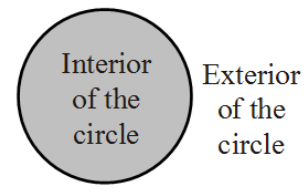
      In a flat surface, the interior of a circle is the line whose distance from the centre is less than the radius. 

      The exterior of a circle is the line in the plane whose distance from the centre is larger than the radius.

      Terms related to circle

      Arc

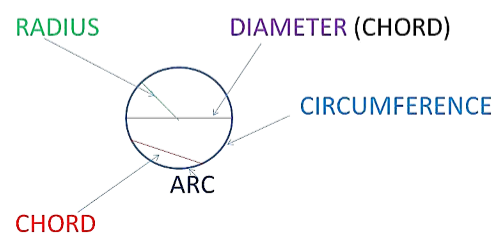
      • Chord: Any straight line segment that’s both endpoints falls on the boundary of the circle is known as Chord. In Latin, it means ‘bowstring’.
      • Diameter: Any straight line segment or Chord which passes through the centre of the Circle and its endpoints connects on the boundary of the Circle is known as the Diameter of Circle. So in a circle Diameter is the longest chord possible in a circle.
      • Arc: Any smooth curve joining two points is known as Arc. So in Circle, we can have two possible Arcs, the bigger one is known as Major Arc and the smaller one is known as Minor Arc.
      • Circumference: It is the length of the circle if we open and straighten it out to make a line segment.

      Segment and Sector of the Circle

      Segment and Sector of the Circle

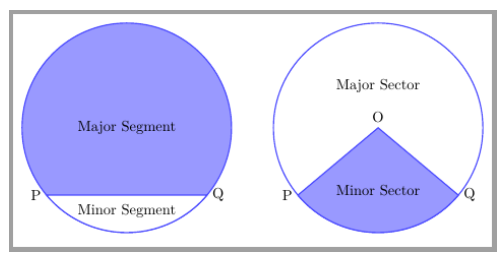
      A segment of the circle is the region between either of its arcs and a chord. It could be a major or minor segment.

      Sector of the circle is the area covered by an arc and two radii joining the centre of the circle. It could be the major or minor sector.

      Angle Subtended by a Chord at a Point

      Angle Subtended by a Chord at a Point

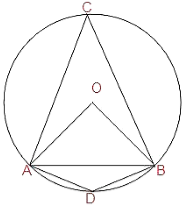
      If in a circle AB is the chord and is making ∠ACB at any point of the circle then this is the angle subtended by the chord AB at a point C.

       Likewise, ∠AOB is the angle subtended by chord AB at point O i.e. at the centre and ∠ADB is also the angle subtended by AB at point D on the circle.

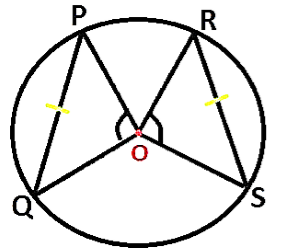
      Theorem 1: Any two equal chords of a circle subtend equal angles at the centre.

      Any two equal chords of a circle subtend equal angles at the centre

      Here in the circle, the two chords are given and PQ = RS with centre O.

      So OP = OS = OQ = OR (all are radii of the circle)

      ∆POQ ≅ ∆SOR

      ∠POQ = ∠SOR  

      This shows that the angles subtended by equal chords to the centre are also equal.

      Theorem 2: If the angles made by the chords of a circle at the centre are equal, then the chords must be equal.

      A perpendicular from the centre of a circle to any chord then it bisects the chord.

      This theorem is the reverse of the above Theorem 1.

      Perpendicular from the Centre to a Chord

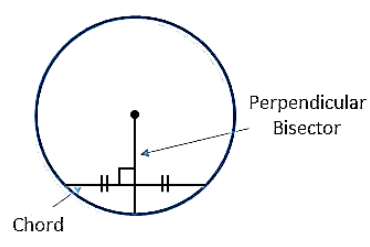
      Theorem 3: If we draw a perpendicular from the centre of a circle to any chord then it bisects the chord.

      If we draw a perpendicular from the centre to the chord of the circle then it will bisect the chord. And the bisector will make a 90° angle to the chord.

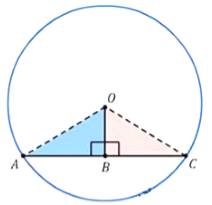
      Theorem 4: The line which is drawn from the centre of a circle to bisect a chord must be perpendicular to the chord.

      The centre of a circle to bisect a chord must be perpendicular to the chord.

      If we draw a line OB from the centre of the circle O to the midpoint of the chord AC i.e. B, then OB is the perpendicular to the chord AB.

      If we join OA and OC, then

      In ∆OBA and ∆OBC,

      AB = BC (B is the midpoint of AC)

      OA = OC (Both are the radii of the same circle)

      OB = OB (same side)

      Hence, ΔOBA ≅ ΔOBC (both are congruent by SSS congruence rule)

      ⇒ ∠OBA = ∠OBC (respective angles of congruent triangles)

      ∠OBA + ∠OBC = ∠ABC = 180° [Linear pair]

      ∠OBC + ∠OBC = 180° [Since ∠OBA = ∠OBC]

      2 x ∠OBC = 180°

      ∠OBC = 90o

      ∠OBC = ∠OBA = 90°

      ∴ OB ⊥ AC

      Circle through Three Points

      Theorem 5: There is one and only one circle passing through three given non-collinear points.

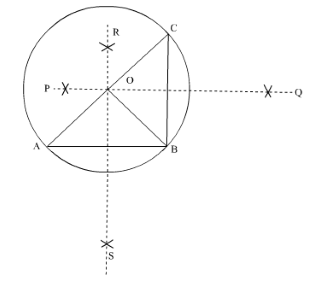
       one and only one circle passing through three given non-collinear points.

      In this figure, we have three non-collinear points A, B and C. Let us join AB and BC and then make the perpendicular bisector of both so that RS and PQ the perpendicular bisector of AB and BC respectively meet each other at Point O.

      Now take the O as centre and OA as the radius to draw the circle which passes through the three points A, B and C.

      This circle is known as Circumcircle. Its centre and radius are known as the Circumcenter and Circumradius.

      Equal Chords and Their Distances from the Centre

      Theorem 6: Two equal chords of a circle are at equal distance from the centre.

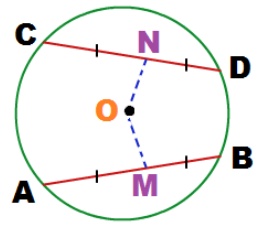
      Two equal chords of a circle are at equal distance from the centre.

      AB and CD are the two equal chords in the circle. If we draw the perpendicular bisector of these chords then the line segment from the centre to the chord is the distance of the chord from the centre.

      If the chords are of equal size then their distance from the centre will also be equal.

      Theorem 7: Chords at equal distance from the centre of a circle are also equal in length. This is the reverse of the above theorem which says that if the distance between the centre and the chords are equal then they must be of equal length.

      Angle Subtended by an Arc of a Circle

      Angle Subtended by an Arc of a Circle

      The angle made by two different equal arcs to the centre of the circle will also be equal.

      There are two arcs in the circle AB and CD which are equal in length.

      So ∠AOB = ∠COD.

      Theorem 8: The angle subtended by an arc at the centre is twice the angle subtended by the same arc at some other point on the remaining part of the circle.

       The angle subtended by an arc at the centre is twice the angle subtended by the same arc

      In the above figure ∠POQ = 2∠PRQ.

      Theorem 9: Angles from a common chord which are on the same segment of a circle are always equal.

      Angles from a common chord which are on the same segment of a circle are always equal.

      If there are two angles subtended from a chord to any point on the circle which are on the same segment of the circle then they will be equal.

      ∠a = (1/2) ∠c (By theorem 8)

      ∠b = (1/2) ∠c

      ∠a = ∠b

      Cyclic Quadrilaterals

      If all the vertices of the quadrilateral come in a circle then it is said to be a cyclic quadrilateral.

      Theorem 10: Any pair of opposite angles of a cyclic quadrilateral has the sum of 180º.

      Cyclic Quadrilaterals

      ∠A + ∠B + ∠C + ∠D = 360º (angle sum property of a quadrilateral)

      ∠A + ∠C = 180°

      ∠B + ∠D = 180º

      Theorem 11: If the pair of opposite angles of a quadrilateral has a sum of 180º, then the quadrilateral will be cyclic.

      This is the reverse of the above theorem.

      Hindi Version

      Key Terms

      Topic Terminology

      Term

      Important Tables

      Table:

      .

      Thumbnail - Study, Assess, Interact
      Advanced Tools For Study Assess Interact
      • COMBUSTION AND FLAME | Study

        Mind Map Overal Idea Content Speed Notes Quick Coverage Combustion: The process of burning a substance in the presence of air (oxygen) andundergoes a chemical reaction to produce heat and light. The substances which burn in air are called combustible. Oxygen (in air) is essential for combustion. During the process of combustion, heat and light readmore

        Mind Map

        Overal Idea

        Content

        Speed Notes

        Quick Coverage

        Combustion: The process of burning a substance in the presence of air (oxygen) andundergoes a chemical reaction to produce heat and light. The substances which burn in air are called combustible.

        Oxygen (in air) is essential for combustion. During the process of combustion, heat and light are given out. Ignition temperature is the lowest temperature at which a combustible substancecatches fire.

        Types of combustion: The type of combustion differs depending on the type of fuel. (Scroll down till end of the page)

        Study Tools

        Audio, Visual & Digital Content

        Based on nature and intensity combustions are classified into three types. They are:
        (i) Rapid combustion
        (ii) Spontaneous combustion
        (iii) Explosion

        Flame: It is a zone or burning vapour. The substances which vaporise during
        burning give flames.

        Example: Kerosene oil and molten wax. Inflammable substances have very low ignition temperature. Fire can be controlled by removing one or more requirements essential for producing fire. Water is commonly used to control fires. Water cannot be used to control fires involving electrical equipments or oils.

        There are three different zones of a flame – dark zone, luminous zone and non-luminous zone.

        Fuel is any material that is burned to obtain energy that can be used to heat or
        A good fuel must:

        Oxides of sulphur and nitrogen produced by the burning of coal, diesel and
        petrol cause Acid rain which is harmful for crops, buildings and soil.

        Be readily
        available. Be cheap. Burn easily at a moderate rate.

        Produce a large amount of heat. • Not leave behind any undesirable
        Fuels differ in their efficiency and cost. Fuel efficiency is expressed in terms of its calorific value which is expressed in
        units of kilo joule per kg.

        Types of Fuels:
        (i) Solid Fuels: Combustible substances which are solid at room
        temperature.Example: coal, coke, wood, charcoal, etc. (ii) Liquid fuels: Volatile liquids which produce combustible vapour. Example:
        Petrol,kerosene, alcohol, diesel, etc. (iii) Gaseous fuels: Combustible gases or mixture of combustible gases. Example:
        Effects of Burning of Fuels:
        (i) Carbon fuels like wood, coal petroleum release un burnt carbon particles. Theseare dangerous pollutants causing respiratory diseases, such as asthma.

        (ii) Incomplete combustion of carbon fuels gives carbon monoxide which
        is apoisonous gas.

        (iii) Increased concentration of carbon dioxide in the air is believed to cause
        globalwarming.

        (iv) Oxides of Sulphur and nitrogen dissolve in rain water and form acids. Such
        rain is Un burnt carbon particles in air are dangerous pollutants causing respiratoryproblems.

        Incomplete combustion of a fuel gives poisonous carbon monoxide gas. Increased percentage of carbon dioxide in air has been linked to global warming.

        Hindi Version

        Key Terms

        Topic Terminology

        Term

        Important Tables

        Table:

        .

        Thumbnail - Study, Assess, Interact
        Advanced Tools For Study Assess Interact
        • CONSERVATION OF PLANTS AND ANIMALS | Assess

          Assessment Tools

          Assign | Assess | Analyse

          Question Bank

          List Of Questions With Key, Aswers & Solutions

          Re – Learn

          Go Back To Learn Again

          • Exploring Magnets | Assess

            Assessment Tools

            Assign | Assess | Analyse

            Question Bank

            List Of Questions With Key, Aswers & Solutions

            Re – Learn

            Go Back To Learn Again

            • Life Processes | Assess

              Assessment Tools

              Assign | Assess | Analyse

              Question Bank

              List Of Questions With Key, Aswers & Solutions

              Re – Learn

              Go Back To Learn Again

              • Lines and Angles | Assess

                Assessment Tools

                Assign | Assess | Analyse

                Question Bank

                List Of Questions With Key, Aswers & Solutions

                Re – Learn

                Go Back To Learn Again

                • Lines and Angles | Assess

                  Assessment Tools

                  Assign | Assess | Analyse

                  Question Bank

                  List Of Questions With Key, Aswers & Solutions

                  Re – Learn

                  Go Back To Learn Again

                  • Lines and Angles | Study

                    Mind Map Overal Idea Content Speed Notes Quick Coverage Point: Point is an exact position in space with no dimensions, represented by a dot. Ray: Ray is a part of a line that starts at an endpoint and extends infinitely away from the end point in single direction. Line or Straight line: A line or readmore

                    Mind Map

                    Overal Idea

                    Content

                    Speed Notes

                    Quick Coverage

                    Point: Point is an exact position in space with no dimensions, represented by a dot.

                    Ray: Ray is a part of a line that starts at an endpoint and extends infinitely away from the end point in single direction.

                    Line or Straight line: A line or straight line is perfectly straight and extends forever in both direction.

                    Line segment: A line segment is the part of a line between two points. (Scroll down till end of the page)

                    Study Tools

                    Audio, Visual & Digital Content

                    Intersecting lines: Two or more lines that have one and only one point in common.

                    Point of intersection: Point of intersection is a common point at which the intersecting lines meet.

                    Transversal: Transversal is a line that intersects two or more lines which lie in the same plane at distinct points.

                    Parallel lines: Parallel lines are the lines on a plane which never meet. They are at a distance apart.

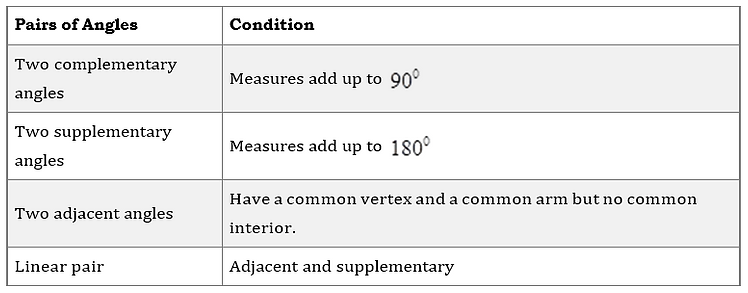
                    Complementary Angles: Complementary angles are the angles whose total is equal to 90o .

                    Supplementary Angles: Suplementary angles are the angles whose total is equal to 180o

                    Adjacent Angles: Adjacent Angles are the angles which have a common vertex and a common interior points.

                    Linear Pair of Angles: Linear pair of angles is a pair of adjacent angles whose non-common sides are opposite rays.

                    Vertically Opposite Angles: Vertically opposite angles are the angles formed by two intersecting lines which have the have common arms.

                    Angles made by Transversal:

                    When two lines are intersecting by a transversal, eight angles are formed.

                    Transversal of Parallel Lines: If two parallel lines are intersected by a transversal, each pair of:

                    • Corresponding angles are congruent.
                    • Alternateinterior angles are congruent.
                    • Alternate exterior angles are congruent.

                    If the transversal is perpendicular to the parallellines, all of the angles formed are congruent to 90o angles.

                    1. A line which intersects two or more given lines at distinct points is called a transversal to the given lines.
                    2. Lines in a plane are parallel if they do not intersect when produced indefinitely in either direction.
                    3. The distance between two intersecting lines is zero.
                    4. The distance between two parallel lines is the same everywhere and is equal to the perpendicular distance between them.

                    If two parallel lines are intersected by a transversal then:

                    • pairs of alternate (interior orexterior) angles are equal.
                    • pairs of corresponding angles are equal.
                    • interior angles onthe same sideof the transversal are supplementary.

                    6. If two non-parallel lines are intersected by transversal then none of (i), (ii) and (iii) hold true in 5. 7.

                    If two lines are intersected by a transversal, then they are parallel if any one of the following is true:

                    • The angles of a pair of corresponding angles are equal.
                    • The angles of a pairof alternate interior angles are equal.
                    • The angles of a pairof interior angles on the sameside of the transversal are supplementary.
                    Hindi Version

                    Key Terms

                    Topic Terminology

                    Term

                    Important Tables

                    Table:

                    .

                    Thumbnail - Study, Assess, Interact
                    Advanced Tools For Study Assess Interact
                    wpChatIcon
                      wpChatIcon
                      error: Content is protected !!
                      Scan the code
                      Verified by MonsterInsights